The search landscape just shifted dramatically under your feet, and if you’re not paying attention, your B2B SaaS brand could lose significant visibility overnight.
Google AI Mode isn’t just another search feature: it’s a complete reimagining of how users discover, evaluate, and interact with information online.
Here’s what should grab your attention immediately: AI Overviews now reach over 1 billion monthly users across 100+ countries (TechCrunch), and Google AI Mode has expanded globally, available on both desktop and mobile platforms. This isn’t a gradual rollout anymore. It’s here, it’s global, and it’s fundamentally changing how your prospects find and evaluate your solutions.
As someone who’s been navigating the SEO landscape for years, I can tell you that this shift is bigger than mobile-first indexing, bigger than RankBrain, and certainly bigger than any core algorithm update we’ve seen. The traditional playbook of keyword optimization and link building, while still relevant, is no longer sufficient. You need to think like an AI to succeed in an AI-powered search world.
In this comprehensive guide, I’ll walk you through everything you need to know about Google AI Mode, its impact on B2B SaaS visibility, and most importantly, the actionable strategies you can implement today to maintain, and even improve your search presence in this new era.
What is Google AI Mode? Understanding the Fundamentals
Let’s start with the basics because understanding what AI Mode actually does is crucial for adapting your strategy effectively.
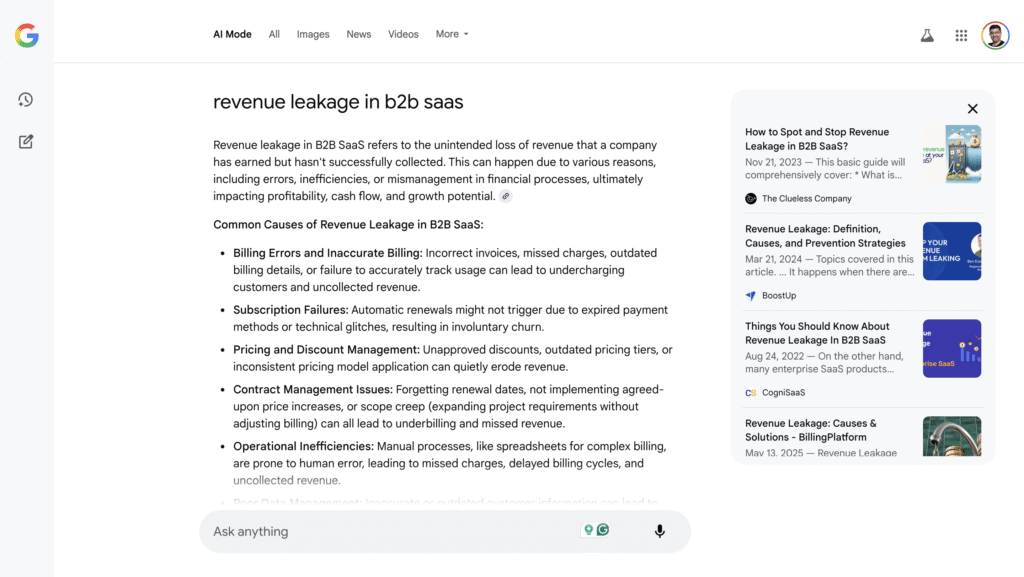
Google AI Mode is a new generative AI experiment in Google Search that fundamentally changes how users interact with search results.
Unlike traditional search where you get a list of links, AI Mode provides conversational, multi-step interactions that can handle complex queries requiring reasoning across multiple topics.
AI Mode vs. AI Overviews: Key Differences
Here’s where many people get confused, so let me clarify:
AI Overviews are the AI-generated summaries that appear at the top of traditional search results. They provide quick answers but maintain the familiar search result format below.
AI Mode is an entirely different experience. When you activate AI Mode, you’re entering a conversational interface where you can:
- Ask follow-up questions without starting over
- Request deeper analysis or comparisons
- Get multi-step reasoning for complex problems
- Receive personalized recommendations based on your specific context
Think of AI Overviews as AI-enhanced traditional search, while AI Mode is more like having a research assistant who can think through problems with you.
Current Global Availability of the Google AI Mode
Google AI Mode rolled out to everyone in the U.S. starting in May 2025, and the feature is now available in India and expanding to more regions globally.
Unlike the initial limited rollout, AI Mode is now accessible on both desktop and mobile devices worldwide, making it a critical consideration for any B2B SaaS brand with global reach.
Core Capabilities of Google AI Mode That Matter for B2B SaaS
AI Mode’s advanced capabilities directly impact how your prospects research and evaluate solutions:
- Multi-step reasoning: Users can ask complex questions like “What are the best project management tools for remote teams with over 50 employees, and how do their pricing models compare for annual contracts?”
- Contextual follow-ups: After getting an initial answer, users can ask “What about security features?” or “How do these integrate with Slack?” without losing context
- Comparative analysis: AI Mode can synthesize information from multiple sources to provide detailed comparisons (exactly what B2B buyers need)
- Research assistance: Users can build comprehensive understanding through guided conversations, reducing the need to visit multiple websites
This shift means your content needs to satisfy not just initial queries, but also the deeper, more nuanced questions that arise during the evaluation process.
The Impact of Google AI Mode on B2B SaaS Search Visibility
Here’s where things get real for your business.
The impact of AI Mode on B2B SaaS visibility is profound and multifaceted, affecting everything from how prospects discover your brand to how they evaluate your solutions.
How AI Mode Changes User Search Behavior
Traditional B2B SaaS search behavior typically follows a predictable pattern: awareness-stage broad searches, consideration-stage specific feature queries, and decision-stage comparison searches. AI Mode compresses this journey into conversational interactions.
Instead of searching for “project management software,” then “project management software for remote teams,” then “Asana vs Monday.com,” users can now have one continuous conversation: “I need project management software for my remote team of 30 people. What are my options, and how do they compare on pricing and features?”
Traditional SEO Metrics vs. AI Mode Reality
This is where many B2B SaaS marketers are getting blindsided. Your traditional metrics viz. click-through rates, organic traffic, keyword rankings, are becoming less reliable indicators of search performance.
Google’s AI Mode hides referrer data, making clicks invisible in Google Search Console and analytics platforms. This means you might be losing traffic without even knowing it, or conversely, you might be gaining brand awareness and consideration without seeing it in your analytics.
Here’s what’s happening to key metrics:
- Organic traffic: Expect initial decreases as AI Mode provides more comprehensive answers directly in search results
- Click-through rates: May decline for informational queries but could improve for high-intent, specific searches
- Brand search volume: Often increases as AI Mode introduces users to new solutions they weren’t previously aware of
- Conversion rates: Can improve when traffic does arrive, as users are more informed and qualified
#TCCRecommends: SaaS SEO metrics you should track
How B2B Buyers Will Use Google AI Mode
Understanding your buyers’ new behavior patterns is crucial for adaptation. Based on early usage patterns, B2B buyers are using AI Mode for:
- Research and Discovery: “What are the latest trends in customer success platforms, and which companies are leading innovation in this space?”
- Detailed Comparisons: “Compare HubSpot, Salesforce, and Pipedrive for a SaaS company with 50-100 employees, focusing on automation capabilities and pricing.”
- Implementation Planning: “If I choose Slack for team communication, what integrations will I need for project management and file sharing?”
- Troubleshooting and Support: “My team is struggling with user adoption of our new CRM. What strategies have worked for other B2B SaaS companies?”
Traffic and Conversion Implications
The traffic impact varies significantly based on your content strategy and market position. Early data suggests:
- Top-of-funnel traffic: May decrease by 20-40% as AI Mode answers basic questions directly
- Mid-funnel traffic: Could increase if your content becomes a primary source for AI responses
- Bottom-funnel traffic: Often improves in quality, with higher conversion rates from more informed visitors
The key is positioning your content to be the authoritative source that AI Mode references, rather than competing with it for attention.
Critical Optimization Strategies for Google AI Mode for Your B2B SaaS
Now let’s get into the actionable strategies that will help you maintain and improve your visibility in the Google AI Mode era. These aren’t theoretical concepts, they’re practical approaches I’ve tested and refined with B2B SaaS clients.
1. Content Structure for AI Comprehension
AI Mode prioritizes content that’s structured for both human readers and machine understanding. Here’s how to optimize your content architecture:
1.1 Use Clear, Hierarchical Structure
Your content should follow a logical progression that AI can easily parse:
- Start with clear definitions and context
- Progress through detailed explanations
- Conclude with specific examples and applications
- Include relevant statistics and supporting data
1.2 Implement Question-Answer Formats
Structure your content to directly answer the questions your prospects are asking:
- “What is [your solution category]?”
- “How does [your solution] compare to [competitor]?”
- “What are the implementation requirements for [your solution]?”
- “What ROI can companies expect from [your solution]?”
1.3 Create Comprehensive Topic Clusters
Instead of isolated blog posts, build interconnected content clusters that cover topics comprehensively:
- Main pillar page covering the broad topic
- Supporting pages diving deep into specific aspects
- Case studies demonstrating real-world applications
- Comparison pages showing how solutions differ
2. Schema Markup and Structured Data Essentials
Schema markup becomes critical for Google AI Mode visibility. Here’s what you need to implement:
2.1 Organization Schema
Ensure AI Mode understands your company structure:
json
{
“@type”: “Organization”,
“name”: “Your Company Name”,
“description”: “Clear description of what you do”,
“foundingDate”: “2020”,
“numberOfEmployees”: “50-100”,
“industry”: “Software”
}
2.2 Product Schema
For your SaaS solutions:
json
{
“@type”: “SoftwareApplication”,
“name”: “Your Product Name”,
“applicationCategory”: “BusinessApplication”,
“offers”: {
“@type”: “Offer”,
“price”: “99.00”,
“priceCurrency”: “USD”
}
}
2.3 FAQ Schema
Essential for capturing common questions:
json
{
“@type”: “FAQPage”,
“mainEntity”: [{
“@type”: “Question”,
“name”: “How does your pricing work?”,
“acceptedAnswer”: {
“@type”: “Answer”,
“text”: “Detailed pricing explanation…”
}
}]
}
3. Building Authority and Expertise Signals
AI Mode heavily weights authoritative sources. Here’s how to establish authority:
3.1 Author Expertise
- Create detailed author bios with relevant credentials
- Link to speaking engagements, publications, and certifications
- Maintain consistent author presence across high-quality content
- Showcase industry recognition and awards
3.2 Content Depth and Accuracy
- Cite reputable sources and include links to supporting data
- Update content regularly with current information
- Provide specific examples and case studies
- Include relevant statistics and benchmarks
3.3 Industry Recognition
- Feature customer testimonials and case studies
- Display industry certifications and partnerships
- Highlight awards and recognition
- Showcase customer logos and success stories
4. Technical Infrastructure Requirements
Your technical setup needs to support AI crawling and understanding:
4.1 Site Speed and Performance
- Ensure fast loading times (under 2 seconds)
- Optimize for mobile-first indexing
- Use efficient hosting and CDN solutions
- Minimize JavaScript-heavy implementations
4.2 URL Structure and Navigation
- Create clear, descriptive URLs
- Implement logical site architecture
- Use breadcrumb navigation
- Ensure easy internal linking
4.3 Content Accessibility
- Use proper heading hierarchy (H1, H2, H3)
- Include alt text for images
- Ensure proper contrast ratios
- Implement clean, semantic HTML
AEO (Answer Engine Optimization) Best Practices
Answer Engine Optimization represents the evolution of SEO for the AI age. While traditional SEO focuses on ranking in search results, AEO focuses on being the source that AI systems reference and cite.
1. AEO Fundamentals for B2B SaaS
The core principle of AEO is simple: create content that’s so comprehensive, accurate, and well-structured that AI systems naturally choose it as their primary source for information.
1.1 Focus on Completeness Over Keywords
Instead of targeting specific keywords, create content that completely addresses user intent:
- Answer the primary question thoroughly
- Anticipate and address follow-up questions
- Provide context and background information
- Include relevant examples and use cases
1.2 Optimize for Context, Not Just Queries
AI Mode understands context better than traditional search. Your content should:
- Define technical terms clearly
- Explain industry-specific concepts
- Provide background information for complex topics
- Connect related concepts and ideas
2. Content Formats That Win in AI Mode
Based on analysis of AI Mode responses and the types of content that consistently get referenced and cited, certain formats perform significantly better than others.
Understanding these formats and implementing them strategically can dramatically improve your AEO performance.
2.1 Comprehensive Guides
AI Mode heavily favors comprehensive, authoritative guides that cover topics thoroughly. These aren’t just long-form blog posts, they’re resource centers that provide complete coverage of specific topics.
- Step-by-step implementation guides
- Complete buyer’s guides for your product category
- Best practices and frameworks
- Troubleshooting and problem-solving guides
2.2 Comparison Content
AI Mode frequently needs to help users understand options and trade-offs, which makes comparison content extremely valuable. However, your comparison content needs to be more sophisticated than traditional competitive analysis.
- Detailed product comparisons
- Feature-by-feature analysis
- Pricing comparison tables
- Use case-specific recommendations
2.3 Data-Driven Analysis
AI Mode systems heavily favor content that’s backed by data and research. This type of content establishes your authority and provides the factual foundation that AI systems need to confidently reference your content.
- Industry benchmark reports
- Survey results and insights
- Trend analysis and predictions
- ROI calculations and case studies
2.4 Expert Opinions and Commentary
AI Mode systems recognize and value expert opinions and thought leadership content, but this content needs to be substantive and well-supported to be effective.
- Industry trend analysis
- Predictions and future outlook
- Commentary on industry developments
- Expert interviews and insights
3. Building Topical Authority
AI Mode heavily favors sources with established topical authority, which means you need to demonstrate consistent expertise across your area of focus. This requires a long-term approach to content creation and thought leadership development.
3.1 Consistent Content Production
Building topical authority requires consistent publication of high-quality content that demonstrates your expertise over time. This isn’t just about publishing regularly, it’s about maintaining editorial standards and consistently providing valuable insights.
- Publish high-quality content regularly
- Cover topics comprehensively, not superficially
- Maintain editorial standards and fact-checking
- Update existing content with new insights
3.2 Industry Engagement
Building topical authority requires active engagement with your industry community and consistent demonstration of thought leadership. This engagement provides external validation of your expertise and builds the broader authority signals that AI Mode systems evaluate.
- Participate in industry discussions and forums
- Speak at conferences and events
- Collaborate with other industry experts
- Engage with customers and prospects on social media
3.3 Thought Leadership Development
Participate in industry discussions and forums where your expertise adds value. Your participation should be substantive and helpful, not just promotional. AI Mode systems can identify and value genuine expert participation in industry conversations.
- Share unique insights and perspectives
- Take positions on industry issues
- Predict trends and developments
- Provide commentary on industry news
4. Citation-Worthy Content Creation
The ultimate goal of AEO is creating content that AI systems want to reference and cite. This requires a specific approach to content creation that prioritizes accuracy, comprehensiveness, and unique value.
4.1 Accuracy and Reliability
AI Mode systems track the accuracy and reliability of sources over time, which means maintaining high standards for factual accuracy is crucial for long-term AEO success.
- Fact-check all claims and statistics
- Cite reputable sources for data
- Update content regularly
- Correct errors promptly and transparently
4.2 Unique Value and Insights
AI Mode systems prioritize content that provides unique value and insights that can’t be found elsewhere. This means going beyond regurgitating existing information to provide original analysis and perspectives.
- Provide original research and data
- Share unique perspectives and experiences
- Offer practical, actionable advice
- Include real-world examples and case studies
4.3 Comprehensive Coverage
AI Mode systems favor content that provides comprehensive coverage of topics and demonstrates clear authority and expertise. This requires a strategic approach to content creation that builds authority over time.
- Address topics from multiple angles
- Include different viewpoints and approaches
- Provide context and background information
- Anticipate and answer follow-up questions
#TCCRecommends: How to do AEO for B2B SaaS?
Preparing Your B2B SaaS Brand for AI Mode
Preparation is everything in this transition. The brands that start adapting now will have a significant advantage over those who wait. Here’s your strategic roadmap for AI Mode readiness.
Step 1: Content Audit Framework
Start with a comprehensive audit of your existing content using this framework:
1.1 Content Inventory Assessment
- Catalog all existing content assets
- Identify content gaps and opportunities
- Evaluate content quality and accuracy
- Assess content freshness and relevance
1.2 AI Mode Readiness Checklist
For each piece of content, evaluate:
- Does it answer complete questions, not just keywords?
- Is it structured with clear headings and sections?
- Does it include relevant examples and use cases?
- Is it comprehensive enough to stand alone?
- Does it cite credible sources and data?
1.3 Competitive Analysis
- Analyze how competitors appear in AI Mode responses
- Identify content gaps you can fill
- Assess their content quality and depth
- Look for opportunities to provide better information
Step 2: Content Optimization Priority Matrix
Not all content needs immediate attention. Use this matrix to prioritize:
High Priority (Optimize First)
- Content that already ranks well for important terms
- Comprehensive guides and resources
- Comparison pages and buying guides
- Content that drives qualified traffic
Medium Priority (Optimize Second)
- Blog posts with good engagement
- Product documentation and help content
- Industry trend and analysis pieces
- Case studies and success stories
Low Priority (Optimize Later)
- Promotional content and announcements
- Very tactical, step-by-step tutorials
- Company news and updates
- Content with limited search visibility
Step 3: Team Readiness Assessment
Your team needs new skills and approaches for AI Mode success:
3.1 Content Team Development
- Train writers on AI Mode content structure
- Develop expertise in answer-focused writing
- Build research and fact-checking capabilities
- Create content review processes for accuracy
3.2 SEO Team Evolution
- Shift focus from keywords to topics and intent
- Develop expertise in schema markup and structured data
- Build capabilities in content performance analysis
- Learn to track and measure AI Mode visibility
3.3 Marketing Team Alignment
- Understand how AI Mode affects the buyer journey
- Adapt content strategy for new search behaviors
- Develop new metrics and KPIs for success
- Create processes for cross-functional collaboration
Step 4: Implementation Roadmap to Put Your B2B SaaS in the Google AI Mode
Here’s your 90-day implementation plan:
Days 1-30: Foundation Building
- Complete content audit and competitive analysis
- Implement basic schema markup on key pages
- Begin optimizing your top 10 highest-traffic pages
- Set up tracking for AI Mode visibility
Days 31-60: Content Optimization
- Optimize 20-30 additional high-priority pages
- Create 2-3 comprehensive pillar pages
- Implement FAQ schema on relevant pages
- Begin building topical authority clusters
Days 61-90: Scale and Refine
- Expand optimization to medium-priority content
- Create new content specifically for AI Mode
- Develop ongoing monitoring and optimization processes
- Train team on new approaches and techniques
How to Measure Success and KPIs in the AI Mode Era?
Traditional SEO metrics tell only part of the story in the AI Mode era. You need a new measurement framework that captures the full impact of AI-powered search on your business.
1. Beyond Traffic: New Success Metrics
1.1 Brand Mention Tracking
Monitor how often your brand appears in AI Mode responses:
- Brand mention frequency in AI responses
- Context and sentiment of brand mentions
- Comparison mentions with competitors
- Authority and credibility indicators
1.2 Content Citation Analysis
Track how your content is being referenced:
- Citation frequency in AI responses
- Types of content being cited most often
- Accuracy of citations and attributions
- Link-back rates from AI Mode interactions
1.3 Visibility Share Analysis
Measure your share of AI Mode responses:
- Percentage of relevant queries where you appear
- Position and prominence in AI responses
- Competitive visibility comparison
- Topic coverage and authority assessment
2. Tools and Tracking Methods
2.1 AI Mode Monitoring Tools
- Set up alerts for brand mentions in AI responses
- Use specialized AI search monitoring platforms
- Track competitor visibility in AI Mode
- Monitor content citation patterns
2.2 Analytics Integration
Google has added AI Mode traffic data to Search Console, but tracking remains challenging. Here’s what you can do:
- Monitor Search Console for AI Mode impression data
- Track referral traffic patterns and changes
- Use UTM parameters for better attribution
- Implement advanced event tracking
2.3 Custom Tracking Solutions
- Create custom dashboards for AI Mode metrics
- Set up automated reporting for key indicators
- Build alerts for significant changes
- Develop ROI attribution models
3. Competitive Intelligence in AI Mode
3.1 Competitive Visibility Analysis
- Monitor competitor mentions in AI responses
- Track their content citation patterns
- Analyze their schema markup implementation
- Assess their topical authority development
3.2 Content Gap Analysis
- Identify topics where competitors dominate
- Find opportunities for better content
- Analyze successful competitor content formats
- Discover unmet information needs
3.3 Strategic Positioning Assessment
- Evaluate how you’re positioned against competitors
- Identify differentiation opportunities
- Assess brand authority and expertise signals
- Monitor competitive responses to AI Mode
Key Takeaways and Action Items
The transition to Google AI Mode represents the most significant shift in search behavior since the advent of mobile search. Your success depends on how quickly and effectively you adapt your strategy.
Stay ahead of the curve with these resources:
- Google’s AI Mode documentation and updates
- Industry conferences and webinars
- SEO and AEO expert communities
- Beta testing and early access programs
The AI Mode revolution is here, and it’s reshaping how your prospects discover and evaluate B2B SaaS solutions. The brands that adapt quickly and effectively will gain a significant competitive advantage, while those that wait will find themselves increasingly invisible in the new search landscape.
Your next step is clear: begin implementing these strategies today. Start with your highest-priority content, build your team’s capabilities, and create the comprehensive, authoritative content that Google AI Mode values. The future of B2B SaaS search visibility depends on the actions you take right now.
Ready to transform your search strategy for the AI Mode era? The time to act is now. Your competitors are already making moves, and every day you wait is a day of lost opportunity in the new search landscape.
As an SEO and AEO consultant specializing in B2B SaaS, I help brands navigate the transition to AI-powered search. If you need guidance implementing these strategies or want to discuss your specific situation, I’m here to help you maintain and improve your search visibility in the Google AI Mode era.