Table of Contents
In Short
Let’s start with the honest version of how this goes: you launch your SaaS product, set a rock-bottom price to get early traction, and within a few months…BOOM. You’ve landed logos, your pipeline looks healthy, and maybe even a few investors are circling.
But then… expansion slows. Renewals get shaky. Your sales team starts discounting by default. And suddenly, what felt like smart pricing starts choking your growth.
This isn’t just a pricing problem. It’s a sales problem, and it starts the moment you treat pricing as your GTM strategy, not a tactic.
This guide breaks down how penetration pricing really impacts your sales motion; and how to make it work, whether you’re just starting out or scaling post-product-market fit.
What SaaS Founders Get Wrong About Penetration Pricing
Before we go deep, let’s define terms the right way.
What Penetration Pricing Really Means
Penetration pricing isn’t a one-time discount or promotional launch offer.
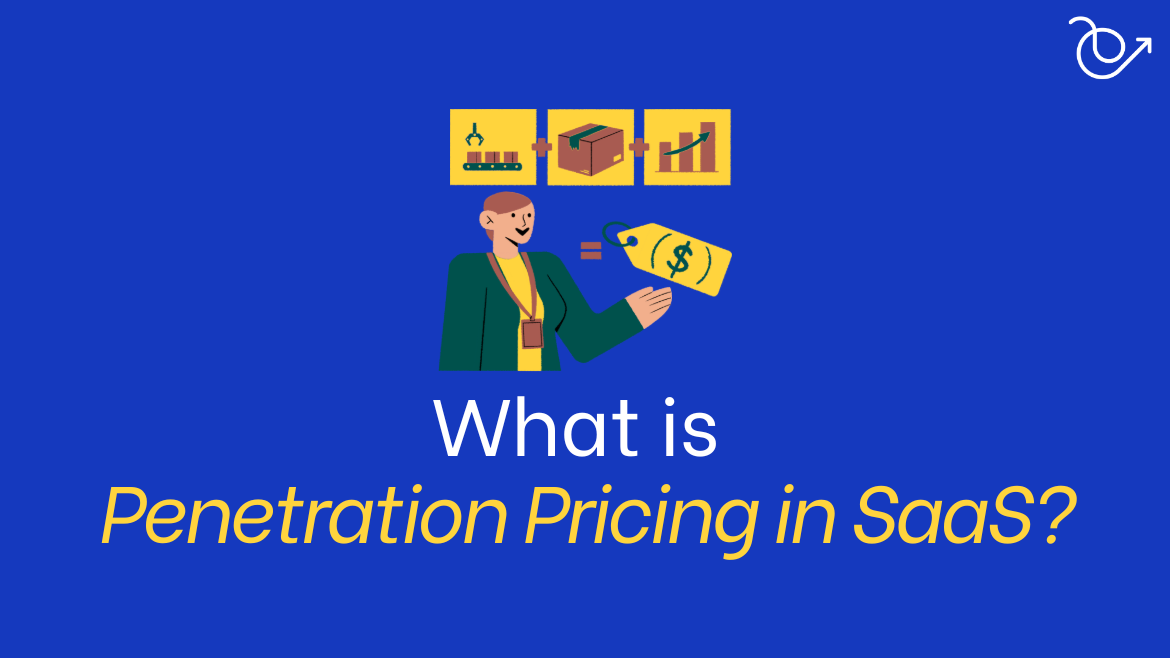
It’s a deliberate strategy to enter the market at a lower-than-normal price point to drive adoption, with the intention of scaling monetization later.
It works when:
- You’re entering a saturated market with entrenched players.
- Your product is easy to adopt and sticky.
- You have a clear path to expansion or upsell.
It backfires when:
- You use low prices to mask a weak sales narrative.
- You attract low-quality customers.
- You don’t operationalize upsell from Day 1.
Why is Penetration Pricing Tempting in SaaS
Especially for early-stage SaaS founders:
- It speeds up logo acquisition.
- It makes sales conversations frictionless (“Why not try it at this price?”).
- It creates surface-level growth that looks great on a pitch deck.
But here’s the trap: most founders assume that every low-ACV customer will grow into a high-ACV customer over time.
Spoiler: they won’t, unless you build an intentional sales strategy to make that happen.
The Sales Impact of Penetration Pricing No One Warns You About
Penetration pricing isn’t just a finance decision. It rewires your sales motion. This is how.
1. You Attract the Wrong Buyers
Low pricing attracts low-commitment buyers:
- Budget-constrained teams
- Junior stakeholders without decision power
- Companies that “just want to try it”
These aren’t the customers who will champion your solution, push for adoption, or expand accounts.
2. Reps Prioritize Speed Over Fit
- Qualification becomes optional.
- Fast deals trump strategic deals.
- You build a sales team that’s trained to close quickly, not sell deeply.
3. Price Becomes a Crutch
Instead of mastering objection handling, reps default to:
“Let me see if I can get you a better price.”
Over time, this becomes the company’s culture. Not a strategic GTM, just a glorified discount desk.
4. You Anchor the Market
Psychologically, the first number a customer sees becomes their baseline.
When you try to move upstream, they resist. Strong expansion stories and new features won’t matter if they feel you started out as the “cheap tool.”
Customers acquired under penetration pricing show 35% higher price sensitivity at renewal than those brought in at standard pricing (Monetizely).
Before You Use Penetration Pricing in SaaS, Build These Sales Foundations
Want to avoid the pain? Start here.
1. Define a Tight ICP (Don’t Let Price Expand It)
Low pricing doesn’t mean you should target everyone. Nail down:
- Budget range
- Buying authority
- Use case maturity
- Expansion potential
Cheap pricing without ICP discipline = chaotic growth and weak unit economics.
#TCCRecommends: How to Build Your ICP?
2. Sell the Future State
Train your reps (or yourself, if you’re still doing founder-led sales) to paint the picture of:
“Where your team will be in 6 months, not what you get today.”
Use adoption roadmaps, feature unlocks, and benchmarked outcomes in your demo narrative.
#TCCRecommends: Benefits of Sales Training
3. Build Expansion Triggers Into Contracts
Don’t wait for upsell opportunities to appear organically.
- Set upgrade points based on user count, feature usage, or outcomes.
- Automate price step-ups to normalize the idea of growth.
4. Train on Value-Based Objection Handling
Give your sales team battle cards that don’t rely on price. Help them reframe common objections:
- “We don’t have a budget” → “Let’s quantify what your current inefficiencies cost.”
- “We’re too early for this” → “That’s exactly why our entry tier exists.”
#TCCRecommends: Best Techniques for Objection Handling
Mid-Stage Warning Signs: When Penetration Pricing Starts to Hurt Your SaaS
This is where experienced founders get caught: in the in-between.
1. Expansion Flatlines
You’ve won deals, but NRR (Net Revenue Retention) is stuck under 100%.
Benchmark: Top SaaS companies derive 30–50% of their growth from expansion revenue. If yours is lagging, pricing may be the bottleneck (ChartMogul).
2. CS & Onboarding Teams Are Drowning
Low-ACV accounts often need disproportionate support:
- Custom onboarding
- Feature gaps
- Constant hand-holding
If CS is overwhelmed, expansion accounts suffer.
3. Sales Becomes a Volume Game
Reps are incentivized to “close anything.” It looks like growth, until churn catches up.
4. You’re Losing Good Reps
Top AEs hate selling on price. They want to lead with value, sell complex deals, and earn on outcomes.
If you’ve built a pricing-driven sales culture, you’ll struggle to keep them.
#TCCRecommends: AE or SDR: Who to Hire For Your SaaS Sales Team?
How to Use Penetration Pricing for SaaS Strategically
Here’s what it looks like when done right, especially at scale.
1. Sell With Milestones, Not Discounts
Frame the entry price as part of a structured growth path:
“This pricing is for your first team. When we roll out to your next business unit, we’ll revisit.”
It makes upgrades feel logical, not aggressive.
2. Run Reverse Trials
Instead of offering your cheapest tier, give customers full access for 30 days, then dial back unless they commit.
This creates urgency, builds buy-in, and anchors value.
#TCCRecommends: Heard of Negative Reverse Selling?
3. Turn Champions Into Internal Sellers
Enable buyers to sell internally with:
- ROI decks
- Adoption benchmarks
- Case studies from similar companies
Low price + no expansion story = dead deal. Low price + internal momentum = future ACV.
4. Position Your Price as Temporary (But Earned)
Let buyers know:
“We’re working with early customers at this rate to gather insight and drive adoption. Long-term pricing aligns with value delivered.”
This frames the low price as part of your go-to-market evolution, and not your brand identity.
Metrics That Actually Matter (and Reveal What Pricing Is Doing)
| Metric | What It Shows | Red Flag |
|---|---|---|
| ASP by Segment | Are your AEs selling upmarket or down? | If ASP is falling while win rate rises, pricing is masking poor fit |
| 90-Day Expansion Rate | Are deals growing fast enough? | If \< 25% expand in 90 days, pricing isn’t leading to value |
| Churn by ACV | Are low-paying customers leaving faster? | If yes, revisit ICP and pricing model |
| Discount Usage | Are reps overly reliant? | Spikes = weak value narrative |
| Rep Retention | Are your best sellers sticking around? | Turnover = comp model or pricing friction |
Average SaaS churn hovers at 3–5% annually, but that number can balloon when penetration pricing attracts the wrong segment (Vitally).
When It’s Time to Pivot from SaaS Penetration Pricing (and How to Do It Without Losing Momentum)
Low pricing doesn’t need to be permanent. But shifting requires planning.
1. Move by Cohort
Test higher pricing on new segments first. Watch conversion, ASP, and expansion metrics closely.
2. Realign Incentives
Tie compensation to:
- Expansion ACV
- Multi-year contracts
- Upsell conversion
This reinforces behavior that supports healthy revenue, not just raw volume.
#TCCRecommends: How to Build SaaS Sales Incentive Structure?
3. Refresh Your Messaging
Update your:
- Case studies
- Competitor comparisons
- Pricing page narrative
Show why your product is no longer just the “affordable” option, it’s the strategic one.
Final Word: Don’t Let Pricing Define Your SaaS Sales Strategy
Penetration pricing in SaaS is a scalpel, not a sledgehammer.
Use it when:
- You have a plan to expand every account you land.
- Your sales team can articulate value from Day 1.
- Your product is sticky enough to grow usage and revenue over time.
But if you’re stuck selling on price, struggling with expansion, and losing rep confidence, it’s time to level up your strategy.
Let your pricing reflect your value, and not your desperation.
- My demos don't close
- 28/08/2026
Most teams document the steps and skip the criteria. That is why reps still need you in the room before anything moves forward.
- 6 minutes reAD
- My demos don't close
- 18/08/2026
The thing that got you your first fifty customers is the thing capping you at the next fifty. Here is where the handoff actually breaks.
- 6 minutes reAD
- My demos don't close
- 04/08/2026
The five places B2B SaaS deals stall between demo and signature, and what fixes each one.
- 7 minutes reAD
Read it before your competitors do.
Reading is one thing. Fixing is another.
If something you read here sounds like your business, get on a call. We will show you exactly what to do about it.
3 new clients a quarter. That is all we take.
3 in 4
Clients come back for more
11 weeks
From stuck to a working revenue system