Revenue Operations (RevOps) is the strategic growth engine B2B SaaS companies can’t afford to skip.
If your marketing, sales, and customer success teams are operating in separate silos; each with their own tools, processes, and targets, then you’re likely experiencing revenue leaks, forecasting inaccuracies, and stagnating growth.
Consider this:
- Leads generated by marketing may never become opportunities.
- Sales deals drag on because reps lack clear handoff processes from marketing.
- Customer Success misses renewal triggers due to fragmented data.
- Finance can’t pinpoint which channels drive ROI, leading to budgeting guesswork.
This disjointed setup creates frustrating growing pains:
- Misaligned goals: Marketing chases MQLs, Sales hits quotas, and CS tries to retain: none share a single source of truth.
- Disconnected tech stacks: Think 10+ tools with little or no integration.
- Revenue leakage: Leads vanish, renewals slip, upsell chances disappear.
- Forecasting chaos: No reliable pipeline visibility equals unpredictable revenue.
Why RevOps is Your Answer
RevOps enters as the centralized operating model that aligns strategy with execution: building a unified GTM and operations engine that powers acquisition, retention, and expansion.
Here’s why it matters:
- Alignment across teams: All go-to-market roles operate toward the same revenue goals. No more pass-the-baton confusion between marketing, sales, and customer success.
- Unified processes and tech: Standardized workflows and fully-integrated tools create a seamless journey from lead to renewal.
- Data-driven decision-making: Centralized dashboards offer real-time insights into pipeline health, CAC, NRR, CLV, and forecasting accuracy.
- Accelerated growth & profitability: Companies with mature RevOps functions grow 19–34% faster and report 20% higher profitability than those without it (Forrester).
What You’ll Learn in This Guide
This comprehensive guide will walk you through:
- 1. What is Revenue Operations (RevOps)?
- 2. Why RevOps Matters for B2B SaaS Growth
- 3. The Core Pillars of Revenue Operations (RevOps)
- 4. RevOps vs. Other Operational Functions
- 5. How RevOps Moves the Needle on SaaS Growth Metrics
- 6. How to Implement RevOps in SaaS (Step-by-Step)
- Step 1: Diagnose RevOps Maturity & Define Strategy
- Step 2: Map GTM Strategy → RevOps Enablement
- Step 3: Fix the Biggest Revenue Leaks First
- Step 4: Align Teams & Incentives (RevOps as the Glue)
- Step 5: Integrate Tools & Build the Data Layer
- Step 6: Evolve from Operational → Strategic RevOps
- The RevOps Strategy Framework
- Do’s & Don’ts of SaaS RevOps
- 7. Common RevOps Challenges & How to Overcome Them
- 8. RevOps Analytics & Reporting
- 9. Who Owns RevOps in SaaS? Roles, Responsibilities & When to Hire Them
- 9.1 Early Stage ($1M–$3M ARR): Founder + RevOps Consultant
- 9.2 Growth Stage ($3M–$8M ARR): RevOps Specialist + Fractional CRO
- 9.3 Scale Stage ($8M–$15M ARR): Revenue Architect + RevOps Analyst
- 9.4 Enterprise Stage ($15M+ ARR): Full RevOps Team
- 9.5 RevOps Consultant vs fCRO vs Full-time Hire
- Who Should RevOps Report To?
- Quick Role Cheat Sheet
- 10. RevOps & Revenue Management: Pricing, Packaging & Monetization
- 11. The Future of RevOps: AI, Predictive Analytics & Revenue Intelligence
- 12. RevOps in Action: Case Studies & Real-World Examples
- 12. RevOps Resources, Next Steps & How to Get Started
1. What is Revenue Operations (RevOps)?
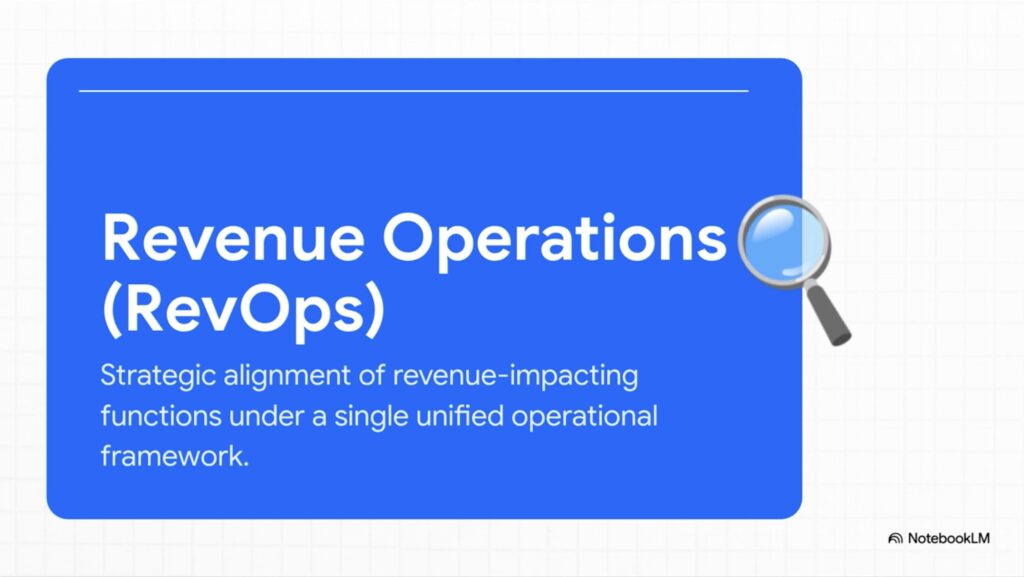
Revenue Operations, or RevOps, is the strategic alignment of all revenue-impacting functions viz. Marketing, Sales, Customer Success, and sometimes Finance—under a single operational framework.
It serves as the unifying backbone of a SaaS organization, ensuring every go-to-market (GTM) team operates with:
- Shared goals instead of siloed metrics
- Standardized workflows instead of fragmented processes
- Integrated tools instead of disconnected tech stacks
- A single source of truth for data instead of conflicting reports
In simpler terms:
RevOps is the operating system for SaaS growth.
It connects your entire customer lifecycle: from lead acquisition to retention and expansion, so you can scale revenue predictably and sustainably.
1.1 Why Does RevOps Exist?
As SaaS companies grow, complexity multiplies:
- Marketing launches campaigns without visibility into downstream conversion.
- Sales chases quotas without knowing which channels deliver the best leads.
- Customer Success struggles with retention because they lack upstream context.
- Leadership receives conflicting reports from different departments.
This creates revenue leaks at every stage of the funnel.
RevOps was born to solve this. It breaks down silos, integrates processes, and aligns GTM teams around the entire revenue journey rather than individual departmental goals.
1.2 The Core Function of RevOps
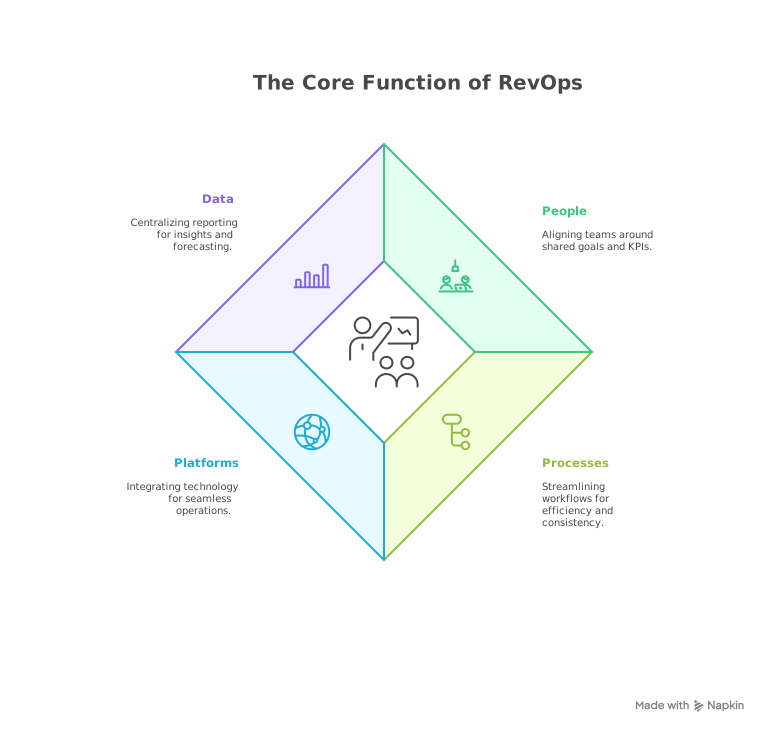
At its core, RevOps focuses on four pillars:
- People: Aligning Marketing, Sales & CS teams around shared KPIs.
- Processes: Streamlining workflows for lead handoffs, deal stages, renewals, and expansions.
- Platforms: Integrating your SaaS tech stack (CRM, marketing automation, CS tools).
- Data: Centralizing reporting for accurate forecasting & performance insights.
Together, these pillars:
✅ Reduce operational inefficiencies
✅ Improve visibility across the entire GTM engine
✅ Drive predictable ARR & NRR growth
1.3 How RevOps Differs from Traditional Ops
Traditional operations roles like Sales Ops or Marketing Ops optimize only one piece of the GTM puzzle. RevOps, on the other hand, orchestrates the entire puzzle, ensuring there are no gaps between functions.
- Sales Ops → focuses only on enabling the sales team.
- Marketing Ops → optimizes campaigns but stops at MQL handoff.
- Customer Success Ops → focuses on retention metrics post-sale.
RevOps unifies them all into one continuous revenue process.
Quick Takeaways
✅ RevOps = alignment of all GTM teams for revenue growth
✅ It removes silos, fixes leaks, and improves forecasting
✅ It combines People, Process, Platform, Data into one cohesive revenue engine
✅ SaaS brands adopting RevOps grow faster & more predictably
2. Why RevOps Matters for B2B SaaS Growth
If you’re running a SaaS company, let me guess what your world looks like right now:
- Your marketing team is generating leads, but Sales often complains they’re not “ready to buy.”
- Your sales team is chasing quotas, but they waste time qualifying inbound leads because there’s no clear scoring or routing process.
- Your customer success team is firefighting churn, but they don’t have the right insights to be proactive.
- And when you, as a founder or GTM leader, ask for a forecast, you get three different numbers from three different teams.
Sound familiar?
This is what happens when your revenue engine is disjointed.
2.1 The Reality of Scaling SaaS Without RevOps
Here’s what typically breaks as you grow from $1M ARR to $10M+ ARR:
- Tool sprawl: You’re using HubSpot for marketing, Salesforce for sales, Zendesk for support, spreadsheets for reporting, but none of it talks to each other.
- Misaligned metrics: Marketing celebrates hitting MQL goals, but Sales misses their quota. CS celebrates NPS but churn creeps up.
- Operational debt: Processes that worked at 10 customers simply collapse when you hit 100.
- Revenue leakage everywhere: Leads fall through the cracks, renewals get delayed, upsell opportunities are missed.
McKinsey calls this the “complexity tax” of SaaS scaling; and if you don’t address it, it slows growth no matter how much you spend on acquisition.
2.2 RevOps: The Antidote to Chaos
RevOps exists to stop this slow bleed. It doesn’t just fix one team, it aligns every GTM function to work like one unified revenue machine.
When you implement RevOps:
- Your marketing campaigns are directly tied to pipeline contribution, not vanity metrics.
- Your sales reps spend more time selling and less time hunting for data.
- Your CS team has proactive churn signals and upsell insights, not just reactive NPS scores (know why NPS is not fully reliable).
- And you finally get a single, trustworthy forecast for revenue.
💡 Here’s a stat worth remembering:

SaaS companies with strong RevOps alignment see 19–34% faster growth and 20% higher profitability, according to research from Forrester.
2.3 The SaaS Metrics RevOps Impacts Most
RevOps directly moves the three core SaaS growth levers:
✅ Acquisition → Your CAC (Customer Acquisition Cost) goes down because you can clearly see which channels and which buyer segments actually convert.
✅ Retention → Your NRR (Net Revenue Retention) improves because your CS team has real insights on customer health, leading to proactive retention efforts.
✅ Expansion → Your CLV (Customer Lifetime Value) goes up because upsells and cross-sells become a deliberate strategy rather than an afterthought.
And when those three levers work in harmony? Your ARR growth curve stops looking like a jagged rollercoaster and starts looking predictable.
2.4 What Happens Without RevOps
Here’s the flip side: SaaS companies that delay RevOps often see these hidden costs stack up:
- 15–20% of MQLs never touched by Sales
- 30–40% of CS team time wasted on manual reporting
- Forecasts off by 20–50%, leading to bad hiring and budgeting decisions
- Unnecessary SaaS tool spend because no one has a full view of the tech stack
When you add it up, you’re literally burning cash every quarter without even realizing it.

2.5 Why Your SaaS Needs RevOps Now, Not Later
The longer you wait, the harder it gets. Here’s why:
- At $1–2M ARR, you can hack your way through misalignment.
- At $5M ARR, the cracks become visible.
- At $10M ARR, the cracks turn into operational fractures that slow your entire GTM motion.
RevOps done early is like compounding interest for operational efficiency, it gets exponentially harder (and more expensive) the later you start. So if you want explosive, predictable, and sustainable growth, RevOps is no longer a “nice to have”: it’s the foundation that lets your SaaS scale without breaking internally.
3. The Core Pillars of Revenue Operations (RevOps)
When you think of RevOps, don’t think of it as just another ops function. Think of it as the framework that makes every SaaS revenue motion smoother, faster, and more predictable.
But here’s the secret: RevOps only works when you build it on four strong pillars. Miss one, and the entire structure becomes wobbly.
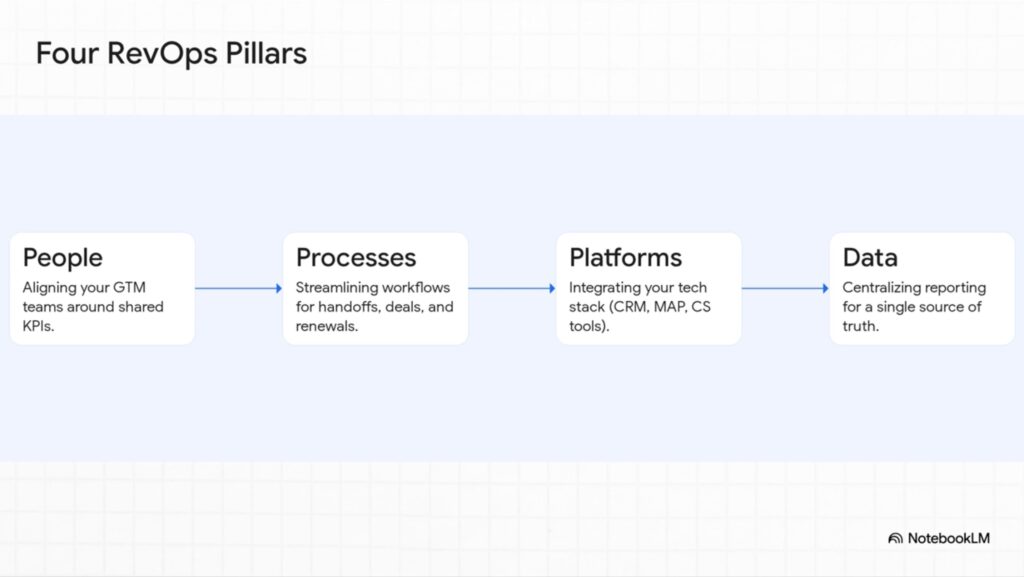
Let’s break them down.
1. People – Aligning Your GTM Teams
When you’re scaling SaaS, misalignment between teams isn’t just annoying; it’s expensive.
- Marketing optimizes for MQLs (not necessarily pipeline).
- Sales chases SQLs but complains about lead quality.
- Customer Success focuses on NPS without a clear upsell or expansion motion.
RevOps fixes this human alignment problem by creating shared revenue goals across the entire operations organization.
✅ Instead of marketing being measured on “leads,” they’re measured on pipeline contribution.
✅ Instead of sales being measured on “closed deals only,” they’re aligned with renewal & expansion goals.
✅ Customer Success shifts from reactive churn-fighting to proactive retention & expansion.
💡 Quick stat: Organizations with strong GTM alignment see 208% higher marketing revenue contribution (HubSpot).
As a SaaS founder or RevOps leader, your job isn’t just aligning tools; it’s aligning humans with one GTM operating model.
2. Processes – Standardizing Workflows
Here’s a hard truth: Scaling chaos is still chaos.
When you’re at $1M ARR, you can survive on ad-hoc processes. But when you’re at $5M, $10M, or beyond, every inconsistency compounds.
RevOps introduces predictable workflows like:
- Lead management: Clear rules for scoring, routing, and follow-up.
- Pipeline stages: Standardized sales stages, so forecasting is accurate.
- Onboarding journeys: Repeatable, automated CS motions for every new customer.
- Renewals & upsells: Proactive CS processes, not just reactive churn handling.
Think of RevOps as the air traffic control for your GTM operations, it ensures no deal, no customer, no opportunity gets lost.
💡 Benchmarks: SaaS companies with structured lead management processes generate 33% more pipeline with the same spend (HubSpot).
3. Platforms – Integrating Your Tech Stack
Let me guess. You’re probably running a SaaS stack that looks like this:
- HubSpot or Marketo for marketing
- Salesforce or Pipedrive for sales
- Zendesk or Intercom for support
- Google Sheets for reporting (don’t deny it 😉)
Individually, these tools are fine. But if they don’t talk to each other? You’re running blind.
RevOps ensures your tech stack is integrated into one ecosystem, so:
- A lead from LinkedIn Ads → syncs into the CRM → triggers a sales follow-up → surfaces in CS for proactive onboarding.
- No more 10 disconnected dashboards. You get a single revenue view.
💡 Forrester found that integrated RevOps platforms can save SaaS teams 10–20% of time otherwise wasted on manual reporting and data cleanup.
RevOps turns your tools from a random pile of SaaS apps into a revenue-generating machine.
4. Data – Your Single Source of Truth
Finally, the most important pillar: data.
Without RevOps, every team has its own version of the truth:
- Marketing says, “We hit 500 MQLs this month.”
- Sales says, “Half were junk.”
- CS says, “Customer health scores don’t match reality.”
With RevOps, you centralize all revenue data so everyone sees the same numbers.
✅ Pipeline coverage
✅ Conversion rates at every stage
✅ CAC, NRR, CLV in real-time
✅ Churn signals & expansion opportunities
This isn’t just about pretty dashboards, it’s about predictability.
💡 Gartner found that SaaS companies using unified RevOps reporting achieve 40% more forecast accuracy, leading to smarter hiring and budgeting decisions.
5. How These Four Pillars Work Together
Think of RevOps like a SaaS growth flywheel:
- Aligned People → follow standardized Processes
- Standardized Processes → run on integrated Platforms
- Integrated Platforms → feed clean, actionable Data
- Clean Data → drives better decision-making, which realigns People
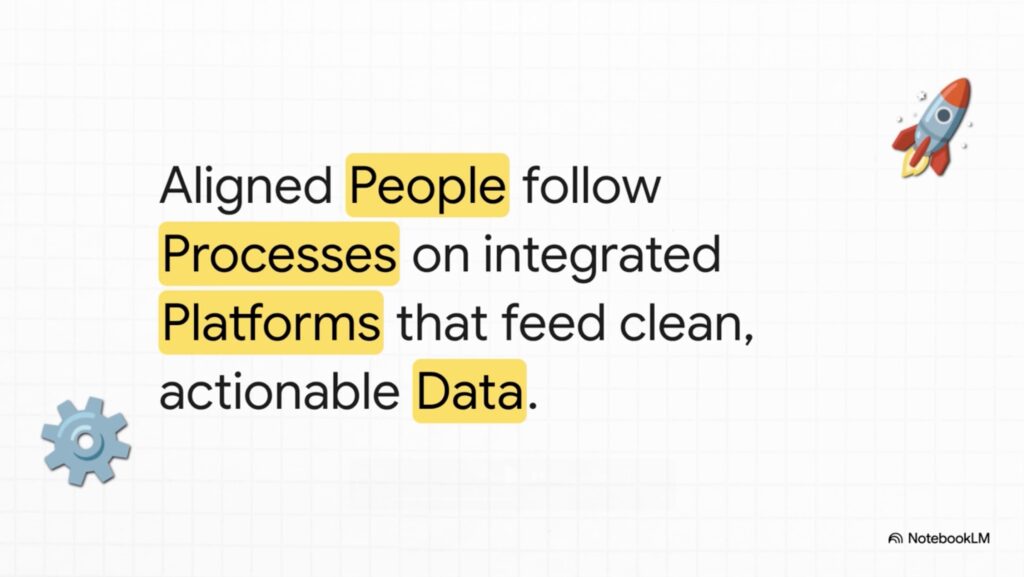
When all four are strong, your GTM engine compounds growth instead of leaking revenue.
3.1 RevOps Best Practices for B2B SaaS
Here are some proven practices we’ve seen across SaaS companies:
✅ Define a GTM charter early – Make sure everyone knows how their metrics ladder up to revenue.
✅ Audit your tech stack quarterly – Eliminate tool overlap & optimize integrations.
✅ Create a RevOps playbook – Document workflows for lead routing, deal stages, renewals.
✅ Invest in RevOps talent early – Don’t wait until $10M ARR to hire your first RevOps lead.
These best practices help SaaS teams scale without chaos.
So, if you want your SaaS to run like a well-oiled growth machine instead of a leaky bucket, you need to strengthen all four pillars: People, Processes, Platforms, and Data.
4. RevOps vs. Other Operational Functions
Here’s a question I hear a lot when I talk to SaaS founders:
“Do I really need RevOps? Can’t I just scale Sales Ops or Marketing Ops?”
It’s a fair question. RevOps, Sales Ops, Marketing Ops, BizOps, and FinOps all sound similar, but they’re NOT the same.
Let’s clear the confusion.
4.1 RevOps vs. Sales Ops
Sales Operations (Sales Ops) focuses purely on helping the sales team sell better. It’s tactical: pipeline hygiene, CRM maintenance, sales enablement, compensation plans.
But here’s the issue: Sales Ops only looks at one part of the funnel.
✅ Sales Ops cares about opportunity-to-close
❌ It doesn’t care about lead-to-opportunity (that’s Marketing’s problem)
❌ It doesn’t care about post-sale retention (that’s CS’s problem)
RevOps, on the other hand, owns the entire revenue journey.
- It connects lead generation → sales conversion → retention & expansion.
- It aligns Marketing, Sales, AND CS around one pipeline—not three separate funnels.
Understanding the Key Difference between RevOps and Sales Ops
While both RevOps and sales aim to eliminate departmental silos and increase revenue, they differ in important ways.
And today, we will discuss the same, so you know which one is best suited for your business.
1. Focus and Scope
Firstly, sales is more focused on just one department as they are typically centered on closing deals and generating revenue.
The RevOps team, as defined above, takes a comprehensive approach and aligns marketing, sales, and customer success to create a seamless customer experience.
Gartner, Inc predicts that by 2025, 75% of the highest growth companies in the world will deploy a revenue operations model.
2. Integration and Collaboration
The sales team works independently, while the RevOps team integrates and collaborates for better functionality of all the departments.
RevOps team works closely with the marketing, sales, and customer support department to operationalize revenue.
3. Metrics and KPIs
Sales team focuses on metrics such as revenue, quotas, and win rates.
RevOps team on the other hand focuses on metrics such as customer acquisition cost (CAC), customer lifetime value (CLV), and customer retention.
Both need to be able to measure their work to know where they stand. This includes defining clear metrics and tracking progress over a period of time.
4. Technology and Tools
Sales teams use tools such as CRM software and email marketing automation platforms.
RevOps uses a variety of technology and tools to streamline processes, such as HubSpot, Zoho, Salesforce etc.
5. Organizational Structure
The division of your sales team into specialized groups is known as sales organizational structure.
This is decided by the number of products or services you offer, the size of your sales team, your target market, and the sales strategies you deploy.
A RevOps organizational structure on the other hand depends on the size and maturity of your company, you can start with an all rounder who takes care of all four key areas: operations, enablement, insights, and tools.
💡 Think of Sales Ops as one piece of the puzzle. RevOps is the entire picture.
4.2 RevOps vs. Marketing Ops
Marketing Operations (Marketing Ops) optimizes marketing campaigns: automation, attribution, segmentation, lead scoring.
It’s essential, but again, it stops at the handoff.
✅ Marketing Ops cares about MQL → SQL conversion
❌ It doesn’t care about what happens after Sales picks up the lead
❌ It doesn’t care about renewal/expansion
RevOps steps in to make sure marketing’s efforts actually translate to revenue.
- It ensures Marketing’s KPIs ladder up to the pipeline, not just leads.
- It fixes lead routing so high-intent leads never slip through.
- It closes the loop between Marketing spend and actual ARR growth.
RevOps vs Marketing Ops: The Comparison
How do they stack up against each other?
- Scope: Marketing Ops is focused solely on the marketing department. RevOps, however, looks at the bigger picture. It focuses on aligning all revenue-generating departments, including marketing.
- Goal: While both roles aim to optimize operations and improve efficiency, they have different end goals. Marketing Ops is about improving the efficacy of the marketing department, while RevOps is about driving revenue growth across the board.
- Tools and Technology: Both roles involve data management and the use of technology. However, Marketing Ops tends to focus on marketing-specific technology, while RevOps looks at technology that impacts the entire revenue process.
💡 Marketing Ops optimizes campaigns. RevOps optimizes the revenue those campaigns generate.
4.3 RevOps vs. BizOps
Business Operations (BizOps) is broader and more strategic. It often works on company-wide initiatives like pricing strategy, market expansion, or organizational design.
BizOps might look at revenue, but it’s not accountable for the GTM engine day-to-day.
✅ BizOps asks “Where should we expand next?”
❌ BizOps doesn’t manage “Why are our leads-to-deals dropping?”
RevOps is laser-focused on the GTM side.
- It owns the execution layer for revenue operations
- It’s responsible for day-to-day alignment of Marketing, Sales, and CS
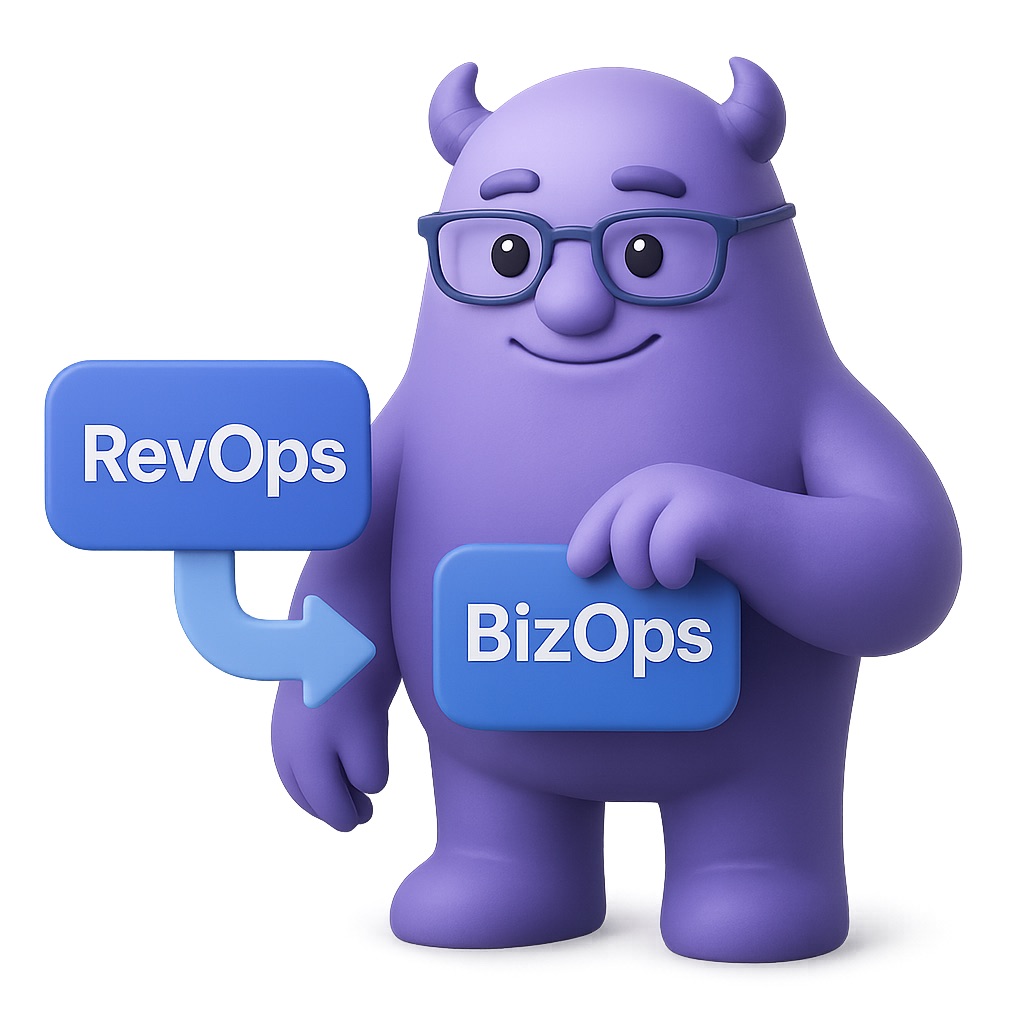
RevOps vs BizOps: The Key Differences
While both RevOps and BizOps focus on increasing efficiency and driving business growth, their primary areas of concentration and the way they operate differ.
- Scope: While RevOps is primarily concerned with revenue-centric functions (sales, marketing, and customer service), business operations cover a broader spectrum, encompassing all operational aspects of a business.
- Objective: RevOps is focused on boosting revenue by mapping the customer journey across the funnel, whereas BizOps aims to improve overall business performance by streamlining all operational activities.
- Measurement Metrics: RevOps utilizes metrics like customer acquisition cost (CAC), customer lifetime value (CLV), churn rate, etc. Business operations, however, involve diverse KPIs across different departments, from operational costs to employee productivity.
💡 So think of BizOps as the strategy hub, while RevOps is the tactical engine that makes the revenue machine run.
4.4 RevOps vs. FinOps
Financial Operations (FinOps) manages spend efficiency, cost optimization, cloud cost control, and ensures financial reporting accuracy.
It looks at the bottom line.
✅ FinOps asks “Are we spending efficiently?”
❌ FinOps doesn’t ask “Are we converting and retaining efficiently?”
RevOps, by contrast, looks at the top line.
- It’s focused on driving ARR/NRR growth
- It optimizes the frontline GTM motions, not just backend finances
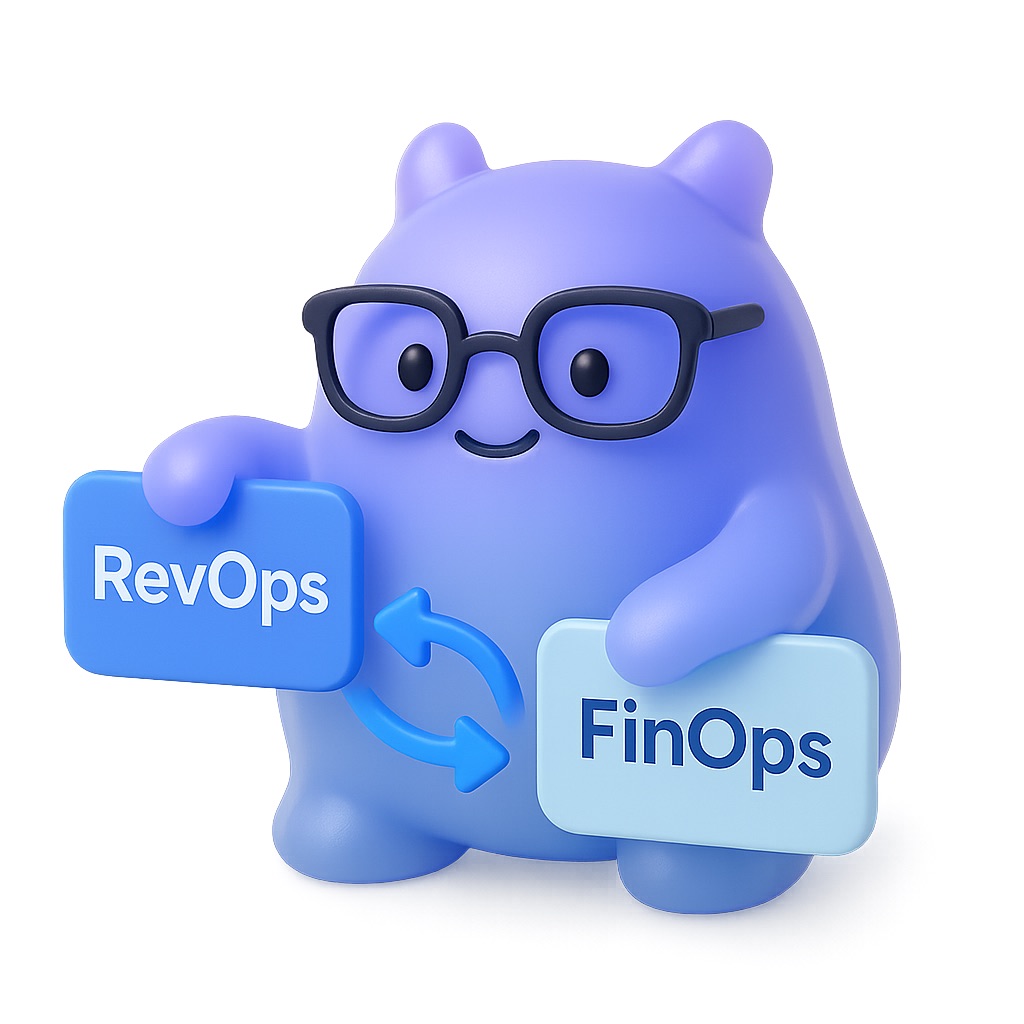
RevOps vs FinOps: Difference Between Both Operations in B2B SaaS
While RevOps and FinOps overlap in their ultimate goal of boosting the company’s financial health (though I think all business operations do that), they differ in their primary focus and operational approach.
- Scope of Work: RevOps concentrates on optimizing revenue streams by aligning marketing, sales, and customer service, whereas FinOps is more focused on the efficient management of financial resources and operations.
RevOps is more operationally focused on the front-end processes that lead to revenue generation, while FinOps deals with broader financial management and strategy. - Focus Area: RevOps emphasizes enhancing the entire customer journey, from initial engagement through post-sales support, to maximize revenue potential. FinOps is more concerned with maintaining the overall financial health of the company and ensuring compliance with financial regulations.
While both are strategic, RevOps tends to be more hands-on with day-to-day operational processes, whereas FinOps takes a higher-level strategic approach to financial management. - Tools and Systems: RevOps often employs CRM and sales enablement and analytics tools to streamline processes and improve customer interactions. FinOps, on the other hand, relies on accounting and financial software and tools for budgeting, forecasting, and financial analysis.
- Metrics and KPIs: RevOps tracks metrics like lead conversion rates, customer acquisition costs, and customer lifetime value which are focused on growth. Check out some RevOps KPIs here. On the other hand, FinOps focuses on metrics such as cash flow, profit margins, and cost of revenue which are pertinent with financial stability.
💡 FinOps ensures you don’t burn cash. RevOps ensures you make more cash.
When Do You Need Each?
- Early-stage SaaS ($1–2M ARR): You can survive with just Marketing Ops & Sales Ops.
- Growth stage ($3–10M ARR): Silos start creating chaos → this is when RevOps becomes essential.
- Scale stage ($10M+ ARR): You’ll likely need RevOps, BizOps, and FinOps working together, each owning different parts of the growth stack.
The Key Takeaway
✅ Sales Ops focuses on sales team efficiency
✅ Marketing Ops focuses on marketing campaigns
✅ BizOps focuses on overall strategy
✅ FinOps focuses on cost & finance efficiency
✅ RevOps connects it all into one cohesive revenue engine
Without RevOps, you’re just optimizing pieces of the funnel in isolation. With RevOps, you’re optimizing the entire revenue lifecycle.
5. How RevOps Moves the Needle on SaaS Growth Metrics
When you think about scaling SaaS, everything ultimately boils down to a handful of critical metrics:
- ARR (Annual Recurring Revenue) – Are we growing consistently?
- NRR (Net Revenue Retention) – Are we keeping AND expanding existing customers?
- CAC (Customer Acquisition Cost) – Are we acquiring efficiently?
- CLV (Customer Lifetime Value) – Are customers staying long enough to be profitable?
- Pricing & Packaging Impact – Are we monetizing our value effectively?
The problem? These metrics are all interconnected. If your CAC is bloated, it eats into CLV. If your NRR is weak, your ARR growth stalls.
RevOps sits at the center of this web, optimizing your entire revenue lifecycle so these metrics work together instead of against each other.
Let’s break it down metric by metric.
5.1 How RevOps Improves ARR (Annual Recurring Revenue)
ARR is the lifeblood of any SaaS business. But here’s the painful reality for many SaaS founders:
Marketing says, “We hit our MQL goal.” Sales says, “We can’t close these leads.” Finance says, “We’re missing ARR targets.”
Why? Because the funnel isn’t connected.
RevOps changes that by:
- Standardizing lead handoffs: No more “Marketing threw this lead over the wall” moments. Leads are routed based on intent and readiness.
- Cleaning up pipeline stages: Every opportunity follows a clear, predictable sales process, reducing leakage.
- Improving forecasting accuracy: With one data source, you finally know how much ARR is coming next quarter.
💡 SaaS benchmark: Companies with integrated RevOps processes see 12–18% faster ARR growth (Forrester).
Example: Imagine a $5M ARR SaaS. Marketing generates 500 leads a month, but only 30% reach Sales. With RevOps streamlining lead scoring and routing, that 30% jumps to 60%, meaning double the pipeline without increasing spend. That alone pushes ARR growth up significantly.
RevOps acts as the bridge between demand generation and revenue realization, making ARR growth predictable instead of accidental.
5.2 How RevOps Improves NRR (Net Revenue Retention)
NRR tells you how healthy your SaaS really is.
A SaaS company can grow ARR fast, but if churn quietly creeps in, the growth collapses.
Without RevOps:
- CS teams rely on gut feel to spot churn risks.
- Renewals are reactive, not proactive.
- Expansion (upsell/cross-sell) is ad-hoc, not systematic.
RevOps fixes this post-sale chaos by:
- Unifying customer health data: CS finally sees usage patterns, adoption scores, and engagement trends in one dashboard.
- Automating renewal workflows: No more missed renewals because someone forgot to follow up (Find the SaaS renewals best practices).
- Triggering data-driven upsell signals: When usage spikes or a customer hits a new threshold, CS gets notified to act.
💡 SaaS benchmark: Top-quartile SaaS companies hit 120–130% NRR because their expansion revenue outpaces churn (KeyBanc SaaS Survey).
Example: Let’s say you have 200 enterprise customers. Before RevOps, your CS team only reacted when a customer complained. With RevOps, you track login frequency, support tickets, and billing history → you proactively identify 20 at-risk accounts 90 days before renewal → you save 80% of them → your NRR jumps from 105% to 120%.
RevOps transforms retention from a reaction into a scalable, proactive system.
5.3 How RevOps Optimizes CAC (Customer Acquisition Cost)
High CAC is the silent killer of SaaS profitability.
Here’s how CAC usually spirals:
- Marketing runs too many campaigns without knowing which channel actually drives the pipeline.
- Sales wastes hours on bad leads because there’s no scoring or routing.
- GTM teams duplicate efforts, creating hidden costs no one sees until Finance calls it out.
RevOps cuts CAC by:
- Attribution clarity: You finally know which channels generate pipeline (not just clicks).
- Better lead scoring & routing: SDRs focus only on leads that match your ICP (Ideal Customer Profile).
- Shorter sales cycles: Standardized processes mean deals close faster → fewer resources wasted (Sales cycle optimization tips here).
💡 HubSpot study: SaaS companies with aligned GTM teams (enabled by RevOps) see 27% lower CAC.
Example: Say you’re spending $50K/month on LinkedIn ads, content syndication, and Google Ads. Without RevOps, you think all of them are working. After RevOps cleans up attribution, you discover LinkedIn ads are generating 80% of pipeline, while syndication barely moves the needle. So you cut $15K/month in wasted spend → CAC drops instantly.
5.4 How RevOps Increases CLV (Customer Lifetime Value)
Your CLV goes up when two things happen:
- Customers stay longer (lower churn)
- Customers buy more (upsell/cross-sell)
Without RevOps, both are left to chance.
RevOps increases CLV by:
- Improving onboarding experience: Automated, personalized onboarding reduces early churn.
- Providing proactive retention triggers: Usage data & churn signals alert CS before it’s too late.
- Systematizing expansion plays: CS knows exactly when and what to upsell based on customer behavior.
💡 Bain & Co stat: A 5% improvement in retention can boost profitability by 25–95%.
Example: Before RevOps, your team only upsells reactively when customers ask for more seats. After RevOps, you set up automated usage thresholds; when an account reaches 80% of their current plan limit, CS is notified to propose an upgrade. Suddenly, upsells become predictable, not accidental, boosting CLV.
5.5 How RevOps Impacts SaaS Pricing & Packaging
Pricing is one of the biggest revenue levers in SaaS, but most pricing decisions are based on gut feel or outdated assumptions.
RevOps changes that by:
- Consolidating usage & adoption data → you see which features truly drive value.
- Surfacing willingness-to-pay insights → from both Sales conversations & CS data.
- Tracking expansion patterns → guiding tiered packaging decisions that maximize upsell potential.
So instead of guessing at your pricing, RevOps lets you optimize pricing with real evidence.
Example: You might think your mid-tier plan is your best seller. But after RevOps consolidates billing + usage data, you find enterprise customers overutilize one feature you underpriced. You adjust pricing, and suddenly ARPU (average revenue per user) jumps by 15%.
#TCCRecommends: A Guide to SaaS Product Pricing
5.6 The Right RevOps KPIs to Monitor
Once RevOps is in place, you don’t just watch ARR or NRR in isolation. You track the leading indicators that reveal revenue leaks early.
The most critical RevOps KPIs include:
- Lead-to-opportunity conversion rate (Is Marketing sending the right leads?)
- Opportunity-to-close win rate (Is Sales working efficiently?)
- Pipeline coverage ratio (Do you have 3–4x coverage for your targets?)
- Sales cycle length (Are deals moving faster?)
- Forecast accuracy (Actual vs Predicted)
- Renewal & churn rate (Is retention stable?)
- Expansion revenue vs. net new revenue (Are you upselling effectively?)
Monitoring these KPIs weekly helps you catch small leaks before they become revenue floods.
The Bigger Picture
When RevOps is done right:
- ARR stops being rollercoaster revenue and becomes predictable ARR.
- NRR goes from barely keeping up with churn to expanding every quarter.
- CAC drops, CLV rises, and your SaaS finally achieves efficient, scalable growth.
That’s why mature SaaS companies treat RevOps as the operating model for growth, not just another ops layer.
6. How to Implement RevOps in SaaS (Step-by-Step)
If you’re serious about RevOps, you can’t just “plug in tools” and hope it works.
RevOps is a strategic operating model; you need both a roadmap AND a strategy behind it.
Here’s how to think about implementing RevOps strategically.
Step 1: Diagnose RevOps Maturity & Define Strategy
Before you even start implementing RevOps, take a strategic pause.
Ask yourself:
- Are we PLG (Product-Led Growth) or SLG (Sales-Led Growth) or CLG (Customer-Led Growth)? Your RevOps design depends on this.
- What’s our North Star metric? ARR? NRR? Expansion revenue?
- Where are the biggest revenue leaks? Acquisition? Conversion? Retention?
This gives you clarity on what RevOps should prioritize first.
💡 Example: If you’re PLG → RevOps focuses more on product usage analytics + CS automation. If you’re SLG → RevOps focuses more on lead routing, pipeline hygiene, forecasting.
Maturity model lens:
- Crawl: Just cleaning CRM & setting basic handoffs
- Walk: Building repeatable GTM processes
- Run: Aligning teams with shared KPIs
- Scale: Predictive RevOps (AI, revenue intelligence)
Step 2: Map GTM Strategy → RevOps Enablement
RevOps must follow your GTM motion.
- If you’re SMB SaaS with high volume leads → RevOps focuses on lead scoring, routing, and SDR automation.
- If you’re Enterprise SaaS with long sales cycles → RevOps focuses on pipeline visibility & forecast accuracy.
- If you’re Hybrid/PLG → RevOps connects product usage data to Sales/CS triggers.
Strategic takeaway: RevOps isn’t “one size fits all”—your RevOps architecture must align with how you acquire and retain revenue.
#TCCRecommends: Enterprise SaaS marketing playbook
Step 3: Fix the Biggest Revenue Leaks First
Don’t try to “boil the ocean.”
Your first RevOps move should be fixing 1–2 critical leaks that give the fastest ROI, such as:
- Marketing → Sales handoff (lost leads = $$$ wasted)
- Pipeline stage chaos (inaccurate forecasting)
- Renewal tracking (missed renewals = silent churn)
💡 Example: A $5M ARR SaaS reduced CAC by 20% just by cleaning up lead scoring & routing. No new tools. No extra ad spend.
#TCCRecommends: How to Spot and Stop Revenue Leakage in B2B SaaS?
Step 4: Align Teams & Incentives (RevOps as the Glue)
RevOps strategy = alignment strategy.
- Marketing stops being measured on MQLs → pipeline contribution instead.
- Sales stops blaming Marketing → shared metrics on SQL-to-win conversion.
- CS stops being “ticket-takers” → gets tied to NRR + expansion goals.
RevOps is the glue that makes all GTM teams row in the same direction.
💡 RevOps strategy isn’t about dashboards, it’s about driving behavior change across GTM.
Step 5: Integrate Tools & Build the Data Layer
Here’s the thing about RevOps, it’s NOT just about buying tools.
You can have the best CRM, MAP, CS platform… but if your processes are broken and teams aren’t aligned, all you’re doing is automating chaos.
That said, the right tech stack is critical to make RevOps scalable and data-driven.
Let’s break down what a RevOps technology stack looks like for SaaS.
1. CRM – Your Single Source of Truth
Your CRM is the heart of RevOps.
It’s where all GTM teams converge:
- Marketing → lead capture & scoring
- Sales → pipeline & deal management
- CS → renewals & expansion tracking
Best for SaaS: HubSpot (mid-market) or Salesforce (enterprise).
💡 RevOps Tip: Your CRM must be the single source of truth; no parallel spreadsheets, no side CRMs.
2. Marketing Automation Platform (MAP)
For Marketing-to-Sales alignment, you need a MAP that:
✅ Automates lead nurturing
✅ Scores leads based on intent & engagement
✅ Syncs bi-directionally with your CRM
Examples: HubSpot, Marketo, Pardot
💡 MAP + CRM integration is often where most RevOps leaks happen; RevOps fixes this.
3. Sales Engagement Tools
To make Sales more efficient:
✅ Automate outreach sequences
✅ Track email & call engagement
✅ Sync back to CRM for complete visibility
Examples: Outreach, Salesloft, Apollo
4. Customer Success Platforms
RevOps doesn’t stop at acquisition, CS tools help track:
✅ Product usage & adoption
✅ Renewal dates & health scores
✅ Upsell & expansion triggers
Examples: Gainsight, ChurnZero, Vitally
5. Revenue Intelligence Platforms
This is where the future of RevOps is headed:
✅ AI analyzes deals, calls & emails → highlights risk & opportunities
✅ Predictive forecasting → tells you which deals are likely to close
✅ Churn risk scoring → proactively alerts CS
Examples: Clari, Gong, BoostUp, People.ai
💡 Think of this as the “RevOps command center” for pipeline health.
6. Data & Analytics Layer
To unify everything, you’ll need a data warehouse + BI tool:
✅ Aggregate CRM + product usage + billing data
✅ Build RevOps dashboards for pipeline, retention, CAC, CLV
✅ Enable predictive analytics
Examples: Snowflake + Looker, BigQuery + Tableau
7. Integration Layer
Your tools won’t work unless they’re connected.
✅ iPaaS tools (Zapier, Workato, Tray.io) automate workflows
✅ Native integrations between CRM, MAP, CS tools
✅ RevOps ensures no data silos remain
How RevOps Chooses & Manages Tech
Here’s what RevOps does strategically with tech:
- Audits your current GTM stack → cuts redundant tools
- Defines what’s mandatory vs nice-to-have
- Ensures tools follow the process, not the other way around
- Sets data governance rules → ensures clean, consistent inputs
💡 Too many SaaS companies have 10+ GTM tools but no unified view of revenue. RevOps fixes this.
RevOps Tech Stack by SaaS Stage
- Early-stage (<$3M ARR): Keep it lean → HubSpot CRM + basic MAP
- Growth-stage ($3M–$10M ARR): Add CS platform + Sales engagement + BI layer
- Scale-stage ($10M+ ARR): Full RevOps stack + Revenue Intelligence + Predictive AI
Bottom line:
The RevOps tech stack is an enabler, not the solution itself.
- RevOps aligns the people & processes first
- Then chooses the right tools to automate & scale
- Then integrates everything into a single revenue engine
With the right tech stack, RevOps becomes frictionless, scalable, and predictable.
#TCCRecommends: How to Fix CRM-Marketing Automation Platform Sync Issues?
Step 6: Evolve from Operational → Strategic RevOps
As your RevOps matures, your strategy shifts:
- Early → “Fix leaks”
- Mid-stage → “Align GTM + scale predictable processes”
- Late-stage → “Drive growth with AI & predictive insights”
Eventually, RevOps stops being “ops cleanup” and becomes your strategic GTM growth engine.
💡 Mature SaaS companies see RevOps not as support, but as the operating system for revenue growth.
The RevOps Strategy Framework
So your RevOps strategy must always answer:
1️⃣ What’s our GTM motion? PLG, SLG, or hybrid?
2️⃣ What’s the biggest revenue priority? Acquisition? Conversion? Retention?
3️⃣ Where are the leaks? Handoffs? Forecasting? Renewals?
4️⃣ What needs alignment first? Teams? Processes? Data?
5️⃣ What’s the maturity goal? Crawl → Walk → Run → Scale
This keeps your RevOps strategy focused, staged, and measurable.
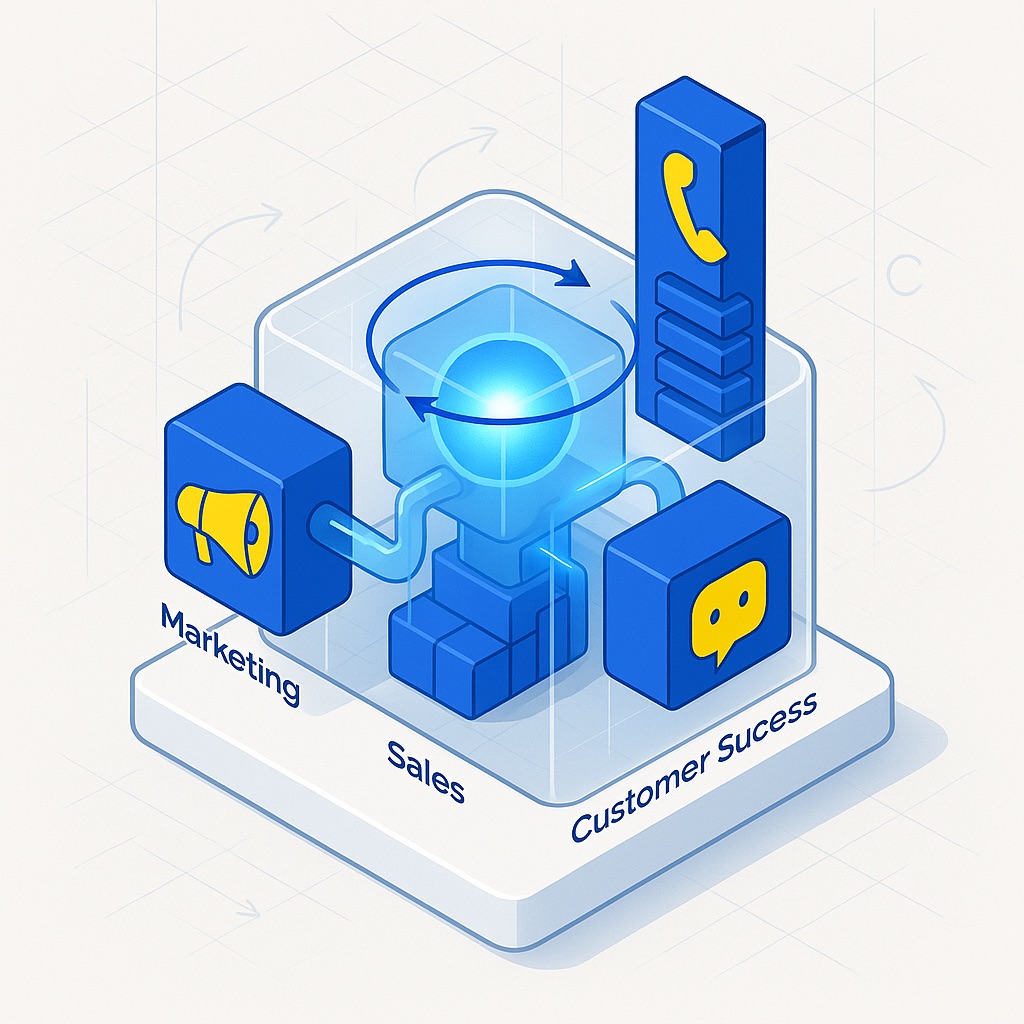
Bottom Line:
RevOps isn’t just an implementation roadmap, it’s a strategic alignment exercise.
- Your GTM strategy defines your RevOps priorities.
- Your maturity defines your RevOps scope.
- Your biggest leaks define your first moves.
Start simple → fix the high-impact leaks → then evolve RevOps into a predictive GTM engine.
Do’s & Don’ts of SaaS RevOps
Before you rush into RevOps implementation, let’s get one thing clear: doing RevOps wrong can actually create more chaos.

So here’s a quick RevOps cheat sheet to keep you on track.
Do’s: What To Do for Successful RevOps
1. Start with a RevOps health check: Map your current GTM processes, tech stack, and data flows. You can’t fix what you can’t see.
2. Align your teams before your tools: RevOps isn’t just a tool integration project, it’s about getting Marketing, Sales & CS to share the same goals.
3. Standardize your GTM processes: Lead routing, opportunity stages, renewals, upsells; document them clearly.
4. Focus on clean, reliable data: Bad data = bad decisions. Audit your CRM & MAP hygiene early.
5. Measure the right KPIs: Don’t drown in vanity metrics: focus on pipeline health, CAC, NRR, CLV, and forecast accuracy.
6. Start small, then scale: Fix 1–2 critical revenue leaks first (e.g., lead handoff, renewals) before trying to automate everything.
7. Communicate changes clearly: Teams will resist process changes if they don’t understand why they’re happening.
Don’ts: What NOT To Do in RevOps
1. Don’t make RevOps “just a tech project”: Buying new tools without fixing processes just automates chaos.
2. Don’t let RevOps report to only one team: If RevOps reports solely to Sales or Marketing, it loses cross-functional neutrality.
3. Don’t overcomplicate from day one: You don’t need 10 dashboards and AI forecasting on day one. Start lean.
4. Don’t ignore CS in RevOps: Retention & expansion are as important as acquisition.
5. Don’t delay RevOps too long: The longer you wait, the harder (and more expensive) it gets to untangle silos.
Bottom line:
Do RevOps with alignment + clarity, and you’ll scale predictably. Do it wrong, and you’ll just create another layer of operational debt.
💡 Pro tip: Think “Crawl → Walk → Run → Scale” when rolling out RevOps. Don’t jump straight to “Run.”
7. Common RevOps Challenges & How to Overcome Them
Even the best SaaS teams struggle when adopting RevOps. Let’s be honest; RevOps isn’t just plug-and-play.
Here are the most common challenges you’ll face, and how to avoid them.
1. Team Resistance to Change
“Why are we changing this? The old way was fine!”
RevOps changes how teams work, measure success, and even how they’re incentivized. Expect resistance.
Fix: Communicate why RevOps matters, show early quick wins (like cleaner lead routing), and involve team leads in the rollout.
2. Bad Data = Bad RevOps
If your CRM is full of duplicates, outdated contacts, and inconsistent fields, RevOps won’t magically fix it.
Fix: Start with a data hygiene project. Standardize fields, clean duplicate records, and set up governance rules for new entries.
3. Tool Sprawl & Poor Integration
Most SaaS teams already have 10+ GTM tools. Adding more without proper integration just creates more silos.
Fix: Audit your stack. Remove overlapping tools. Ensure your CRM, MAP, CS tool, and analytics are fully integrated.
4. No Clear Ownership
Who owns RevOps? Marketing? Sales? CS? Finance? If ownership isn’t clear, nothing moves forward.
Fix: Define clear RevOps ownership based on your ARR stage: early stage → founder, scaling → RevOps Specialist/Consultant, later stage → RevOps Architect/team.
5. Overengineering Too Early
Some SaaS companies overdo RevOps on day one: building 20 dashboards, custom automation, and complex workflows they don’t need yet.
Fix: Focus on 1–2 critical leaks first (e.g., lead routing, renewal workflows). Scale RevOps complexity gradually.
💡 Remember: RevOps challenges are usually people + process problems, not tool problems. Fix alignment before you fix automation.
8. RevOps Analytics & Reporting
One of the biggest value adds of RevOps is giving you clear, trustworthy analytics.
But here’s the hard truth: most SaaS companies have data everywhere, in CRM, spreadsheets, MAP, CS tools: and no single source of truth.
RevOps changes that.
Why RevOps Analytics Matter
✅ Pipeline Visibility → Know how much pipeline you really have, and where deals are stalling.
✅ Forecast Accuracy → Stop guessing revenue. Get reliable ARR/NRR projections.
✅ Revenue Attribution → See which marketing channels actually drive revenue.
✅ Churn & Expansion Signals → Spot retention risks & upsell opportunities early.
💡 Without RevOps analytics, your GTM leaders are flying blind.
Core RevOps Dashboards Every SaaS Needs
1️⃣ Marketing-to-Sales Handoff Dashboard
- MQL → SQL conversion rates
- Lead source performance
- Follow-up SLA compliance
2️⃣ Pipeline Health Dashboard
- Deal stage velocity
- Win rates by segment
- Pipeline coverage ratio (3–4x target ARR)
3️⃣ Revenue Metrics Dashboard
- ARR, NRR, churn, expansion revenue
- CAC & CLV trends over time
4️⃣ Renewals & Expansion Dashboard
- Upcoming renewals (120/90/30 days)
- Product usage adoption metrics
- Expansion triggers
RevOps Analytics Tools & Stack
- CRM (HubSpot, Salesforce) → source of GTM truth
- BI/Analytics (Looker, PowerBI, Tableau) → visualization
- Revenue Intelligence (Clari, Gong) → predictive deal insights
- CS Analytics (Gainsight, ChurnZero) → retention metrics
The key is to connect all of them so RevOps analytics = one unified GTM view.
Bottom line: RevOps analytics turns your scattered GTM data into clear insights your team can act on immediately.
9. Who Owns RevOps in SaaS? Roles, Responsibilities & When to Hire Them
So you know you need RevOps to scale your SaaS, but who actually owns it?
Is it a Specialist? A Consultant? A Fractional CRO? Or a whole team?
The answer is: it depends on your SaaS stage.
RevOps isn’t a single role. It’s a function that evolves as you scale, and the people you need at $3M ARR are very different from what you need at $20M ARR.
Let’s break it down.
9.1 Early Stage ($1M–$3M ARR): Founder + RevOps Consultant
At this stage, you’re still small. Your GTM motions are scrappy, and your CRM is probably messy but just about manageable.
But you’re starting to see pain:
- Leads are slipping through the cracks.
- Reporting is unreliable.
- Marketing/Sales alignment is breaking as you grow.
What you need here → RevOps Consultant (short-term)
✅ They audit your GTM processes and find hidden revenue leaks.
✅ They clean up your CRM and integrate key tools.
✅ They build a basic RevOps roadmap you can execute as you grow.
💡 Think of a RevOps Consultant as a “starter kit” for RevOps; quick wins, no long-term commitment.
9.2 Growth Stage ($3M–$8M ARR): RevOps Specialist + Fractional CRO
Now you’re scaling fast. Your GTM team is growing, but:
- Marketing → Sales handoffs are messy.
- You can’t forecast the sales pipeline with confidence.
- Customer Success is firefighting churn.
This is where you need two layers of help:
9.2.1 RevOps Specialist – your tactical “fixer”
- Cleans your CRM & MAP
- Sets up lead scoring & routing
- Standardizes sales stages & reporting
- Automates basic workflows
9.2.2 Fractional CRO (fCRO) – your strategic GTM leader
- Aligns Marketing, Sales & CS around shared revenue KPIs
- Designs your RevOps operating model
- Oversees process changes & team alignment
- Bridges the gap between ops and strategy
💡 An fCRO gives you CRO-level RevOps alignment without hiring a $300K/year full-time CRO.
Together, they create operational clarity so your SaaS can scale beyond the chaos of “startup GTM.”
9.3 Scale Stage ($8M–$15M ARR): Revenue Architect + RevOps Analyst
Now your SaaS GTM motion is complex:
- Multiple segments (SMB, Mid-market, Enterprise)
- Regional teams with different buyers journey
- A larger CS team managing renewals/upsells at scale
You need someone to design the whole GTM engine for scale → that’s the Revenue Architect.
9.3.1 Revenue Architect
- Designs your end-to-end RevOps framework for scale
- Oversees advanced workflows (e.g. automated renewal & upsell motions)
- Selects & integrates enterprise-level RevOps tools
- Builds forecasting models & GTM dashboards
But you also need someone to turn raw data into insights → that’s the RevOps Analyst.
9.3.2 RevOps Analyst
- Monitors conversion rates & pipeline health
- Flags churn risks with predictive insights
- Tracks forecast accuracy
- Surfaces trends → helps GTM leaders make better decisions
💡 Think of the Revenue Architect as the strategic designer and the Analyst as the data translator.
9.4 Enterprise Stage ($15M+ ARR): Full RevOps Team
At this point, RevOps becomes a full-fledged function, led by a Head/Director of RevOps with specialists for each GTM area:
- Marketing Ops Manager – owns campaign ops & attribution
- Sales Ops Manager – owns pipeline & deal operations
- CS Ops Manager – owns renewals, upsells, and churn prevention
- RevOps Analysts – support with forecasting & insights
And the Director/Head of RevOps reports to CRO/COO, driving org-wide alignment.
9.5 RevOps Consultant vs fCRO vs Full-time Hire
| Role | When You Need Them | Focus |
| RevOps Consultant | Early-stage SaaS ($1M–$3M ARR) | Quick fixes, tool cleanup, roadmap |
| RevOps Specialist | Scaling SaaS ($3M–$8M ARR) | Tactical ops execution |
| Fractional CRO | Scaling SaaS ($3M–$8M ARR) | Strategic GTM alignment + RevOps leadership |
| Revenue Architect | Scale stage ($8M–$15M ARR) | Designing GTM ops for scale |
| RevOps Analyst | Scale stage & beyond | Data → insights |
| Full RevOps Team | Enterprise stage ($15M+ ARR) | Fully owned RevOps function |
Who Should RevOps Report To?
This one’s important:
- Early stage → RevOps (Consultant/Specialist) should report directly to Founder/CEO → because alignment is a strategic priority.
- Mid stage → RevOps should report to CRO/COO → because it’s now a GTM execution function.
- Scale stage → RevOps often becomes its own function, collaborating across GTM + Finance.
The key? RevOps must stay neutral, it shouldn’t be “owned” by just Sales or Marketing, otherwise it loses its cross-functional power.
Quick Role Cheat Sheet
✅ RevOps Specialist → Tactical ops, tool & process fixer
✅ RevOps Analyst → Pipeline & revenue insights
✅ Revenue Architect → GTM ops designer for scale
✅ RevOps Consultant → Short-term ops expertise
✅ Fractional CRO (fCRO) → Part-time GTM leader who aligns strategy + RevOps
Bottom line:
- If you’re small → Consultant or fCRO = fastest way to get RevOps running
- If you’re scaling → Add Specialist + fCRO for tactical + strategic impact
- If you’re mature → Build a Revenue Architect + Analyst + team for full ownership
RevOps isn’t just a hire; it’s a function that grows with your SaaS maturity.
10. RevOps & Revenue Management: Pricing, Packaging & Monetization
Most SaaS founders underestimate how tightly pricing and revenue management connect to RevOps.
You can have the best GTM team in the world, but if your pricing is misaligned with customer value, or if you’re flying blind on how customers actually use your product; you’re leaving money on the table.
This is where RevOps plays a huge role in Revenue Management.
10.1 Why Pricing is a Hidden Revenue Lever
Pricing is one of the highest-impact but least-optimized levers in SaaS.
- Acquisition teams focus on generating more leads.
- Sales teams focus on closing deals faster.
- Customer Success teams focus on retention.
But few SaaS companies actively revisit:
✅ Are we charging for the features customers value most?
✅ Are we missing upsell opportunities with smarter packaging?
✅ Do we know the true willingness-to-pay of each customer segment?
RevOps bridges this gap by surfacing real data on customer behavior, usage, and expansion potential, so you can make evidence-based pricing decisions.
10.2 How RevOps Informs SaaS Pricing & Packaging
Here’s how RevOps impacts your revenue management strategy:
1️⃣ Consolidates Usage Data
RevOps integrates data from your product analytics, CRM, and billing tools.
- You can see which features drive the most usage and retention.
- You can identify “power users” who are more likely to expand into higher tiers.
2️⃣ Reveals Willingness-to-Pay
By combining Sales insights (discount requests, objections) + CS insights (feature adoption, support tickets), RevOps helps you understand what customers are truly willing to pay for.
3️⃣ Guides Packaging Decisions
RevOps data shows which features belong in your free, mid-tier, and enterprise plans based on actual adoption patterns.
4️⃣ Enables Smarter Discounting
Instead of giving blanket discounts, RevOps helps Sales know where discounts improve win rates and where they’re just eating margin (how to manage SaaS discount requests?)
5️⃣ Drives Expansion Plays
RevOps proactively identifies upsell/cross-sell triggers → e.g., when a customer hits 80% of seat usage or API limits → CS gets notified to propose an upgrade.
10.3 Example: RevOps Fixing Pricing Blind Spots
Let’s say you run a SaaS with 3 pricing tiers:
- Starter ($99) → Low usage, high churn
- Pro ($299) → Most popular plan
- Enterprise ($999) → Undersold
Before RevOps, you think Pro is your sweet spot.
After RevOps integrates product usage + CRM + billing:
✅ You discover Enterprise customers overuse 2 premium features → meaning you’re undervaluing them.
✅ You realize 50% of Pro-tier customers consistently exceed usage limits → easy upsell opportunity.
✅ You see churn is highest on Starter because activation rates are low → tweak onboarding + messaging.
Outcome?
- You repackage features → bump ARPU (average revenue per user) by 15%.
- You trigger automatic upsell campaigns → lift expansion revenue by 20% in 6 months.
That’s RevOps turning data → actionable pricing & monetization strategy.
10.4 RevOps + Revenue Forecasting
Revenue management isn’t just pricing, it’s also forecasting accurately.
Without RevOps, your finance team gets three conflicting revenue projections:
- Marketing says pipeline is huge.
- Sales says deals are slow.
- CS says churn is higher than expected.
RevOps unifies all that data into:
✅ Clear renewal forecasts
✅ Reliable upsell/expansion predictions
✅ Accurate new logo pipeline forecasting
This lets you plan budgets, hiring, and growth targets confidently.
💡 SaaS companies with RevOps achieve 40% more forecast accuracy, according to Gartner.
10.5 RevOps Unlocks True Monetization Potential
Think of RevOps as the nervous system for your monetization strategy:
- It tells you who values what, so you price accordingly.
- It tells you when to upsell, so you maximize CLV.
- It tells you where revenue is leaking, so you fix it before it impacts growth.
Without RevOps, you’re guessing. With RevOps, you’re monetizing deliberately.
Key Takeaways:
✅ RevOps gives you real usage data → smarter pricing
✅ RevOps aligns Sales, CS, and Finance on monetization opportunities
✅ RevOps reduces discounting waste & improves ARPU
✅ RevOps makes revenue predictable, not reactive
In short, RevOps doesn’t just help you earn revenue, it helps you keep and grow it intelligently.
11. The Future of RevOps: AI, Predictive Analytics & Revenue Intelligence
Here’s the truth:
RevOps today is where Marketing Automation was 10 years ago—still maturing, but about to become an absolute must-have for scaling SaaS.
We’re entering a new era of RevOps; one where AI doesn’t just support operations, it transforms them.
Think about it:
- How much time do your GTM teams waste cleaning data, updating CRMs, and chasing basic reports?
- How much pipeline is lost because Sales focuses on the wrong deals?
- How much churn sneaks up on you because CS doesn’t see warning signs early enough?
AI is about to change all of that.
11.1 How AI Is Supercharging RevOps
AI takes RevOps from manual cleanup → predictive growth orchestration by:
1. Automating repetitive ops tasks
- CRM data enrichment → no more stale records
- Lead scoring & routing → ML prioritizes the most convertible leads
- Pipeline hygiene → AI flags duplicates, dead deals, and inconsistencies automatically
2. Predicting outcomes before they happen
- Deal win probability → AI scans call transcripts, email sentiment, and engagement scores
- Churn risk → AI detects drop-offs in product usage, support tickets, and payment behavior
- Upsell triggers → AI identifies when a customer is ready for expansion
3. Optimizing GTM strategy in real time
- AI shows which campaigns drive real pipeline, not just clicks
- AI analyzes Sales calls to highlight top-performing talk tracks
- AI suggests next best actions for SDRs, AEs, and CS teams
💡 Forrester reports that SaaS companies adopting AI in RevOps see up to 30% faster pipeline velocity and 20% better forecast accuracy within 12 months.
11.2 AI + RevOps Use Cases in SaaS
Here’s what it looks like in action:
- In Marketing Ops: AI scoring filters out junk leads and highlights ICP-fit prospects in real-time.
- In Sales Ops: AI flags deals going “cold” and recommends the next step to re-engage.
- In CS Ops: AI predicts churn based on product usage drop-offs 90 days before renewal.
- In Pricing/Revenue Management: AI analyzes usage + win-loss data → recommends optimized pricing & packaging.
So instead of teams reacting after the leak happens, AI-enabled RevOps prevents revenue leaks proactively.
11.3 Revenue Intelligence Platforms = The New RevOps HQ
We’re already seeing tools like Gong, Clari, BoostUp, People.ai become the central nervous system for RevOps, pulling in data from:
- CRM
- Call transcripts
- Product analytics
- Billing & finance tools
These platforms unify all signals into a single dashboard with:
✅ Deal health scores
✅ Renewal risk scores
✅ Expansion opportunity alerts
This is the future:
- No more manual dashboards → AI delivers live GTM health reports
- No more pipeline guessing → AI shows exactly which deals will close this quarter
- No more reactive churn management → AI predicts at-risk accounts months ahead
11.4 AI Won’t Replace RevOps, It’ll Elevate It
Some SaaS leaders worry, “Will AI replace RevOps?” The answer is no, it will make RevOps 10x more strategic.
- AI handles the grunt work (data hygiene, routing, basic reporting).
- Humans focus on high-value work (GTM alignment, pricing decisions, strategy).
The RevOps team of the future will look like:
- RevOps Strategist → aligns GTM teams, focuses on revenue growth strategy
- AI Ops Manager → manages AI workflows & automation
- Revenue Analyst → validates AI insights and translates them into actions
11.5 Why You Need a Solid RevOps Foundation Before AI
Here’s the catch: AI can’t fix bad processes.
If your CRM is a mess, if your lead routing is inconsistent, or if your teams aren’t aligned → AI will just amplify the chaos.
That’s why you need basic RevOps hygiene first:
✅ Unified GTM processes
✅ Clean data
✅ Aligned metrics
Then you layer AI on top to scale predictively.
💡 Think of RevOps as the “road” and AI as the “self-driving car.” If the road is broken, the car still crashes.
11.6 Bottom Line: Predictive RevOps is the Future
The future of SaaS GTM is RevOps + AI → Revenue Intelligence.
- Fewer silos, more visibility
- Fewer manual tasks, more automation
- Fewer surprises, more predictability
AI will make RevOps the strategic growth command center of SaaS—one that doesn’t just report on revenue but actively drives it.
12. RevOps in Action: Case Studies & Real-World Examples
Theory is great, but let’s look at how RevOps actually works in practice for SaaS companies at different growth stages.
Case Study 1: Yanolja Cloud (Hospitality SaaS) – Fixing GTM Handoffs → 18% CAC Reduction
When I led marketing ops at Yanolja Cloud (formerly eZee), the world’s #2 hospitality SaaS, we faced a familiar SaaS scaling challenge:
- Marketing generated thousands of MQLs/month from global campaigns.
- Sales reps were overwhelmed and cherry-picking leads → many high-intent prospects were ignored.
- Pipeline reports from HubSpot didn’t match what Finance saw → forecasting was chaos.
What we implemented through RevOps:
✅ Lead scoring & routing automation → prioritized high-intent hospitality chains vs. long-tail leads.
✅ Standardized pipeline stages → eliminated 20+ inconsistent deal stages.
✅ Marketing → Sales → CS alignment sessions → shared KPIs tied to pipeline & ARR, not just leads.
✅ Integrated MarTech stack with CRM → no more double data entry.
Result after 6 months:
- 18% reduction in CAC (Sales wasted less time on junk leads)
- 26% increase in SQL-to-win rate
- Forecast accuracy improved by 30% → Finance could plan with confidence.
💡 Lesson: Fixing just the Marketing → Sales handoff unlocked significant ARR growth without increasing ad spend.
Case Study 2: Mid-Market SaaS – From Reactive Renewals → 120% NRR
A $7M ARR B2B SaaS in the HRTech space had good new logo acquisition but struggled with retention:
- Renewals were handled manually by CS reps → many were missed.
- Churn risks were only visible after customers complained.
- Upsells were accidental—there was no systematic motion.
What we did with RevOps:
✅ Built automated renewal workflows in the billing system → renewal reminders triggered at 120, 90, and 30 days.
✅ Integrated product usage analytics into CS dashboards → flagged accounts with low adoption before renewal.
✅ Created usage-based upsell triggers → when a customer hit 80% of seat limits, CS was notified.
✅ Tied CS incentives to expansion revenue, not just retention.
Result after 9 months:
- NRR jumped from 102% → 120%
- Renewal rate improved by 15%
- Upsells contributed 20% of total revenue (vs. 5% before)
💡 Lesson: RevOps isn’t just for acquisition—it makes retention & expansion predictable and scalable.
Case Study 3: Enterprise SaaS – Predictive Forecasting with RevOps
A $15M ARR Enterprise SaaS had large deal sizes but very long sales cycles. The leadership team constantly asked:
“Which deals are actually going to close this quarter?”
Sales reps would give subjective forecasts, and Finance had zero confidence in revenue projections.
RevOps changes implemented:
✅ Integrated Salesforce + Gong + Clari → deal engagement scores replaced gut-feel.
✅ Cleaned pipeline stages → eliminated 50+ “stuck” opportunities.
✅ Built predictive forecasting model → AI identified which deals had 80%+ win likelihood.
✅ Created weekly RevOps GTM syncs → Sales, Marketing, CS all looked at the same data.
Result after 6 months:
- Forecast accuracy improved from ~50% → 92%
- Sales cycle time reduced by 23% (reps focused only on winnable deals)
- Leadership gained clear visibility → enabled smarter hiring & budget allocation.
💡 Lesson: Predictive RevOps + revenue intelligence platforms make enterprise SaaS forecasting reliable, not guesswork.
What Do These Case Studies Prove?
Across different SaaS stages, RevOps delivers tangible outcomes:
✅ For SMB SaaS: Lower CAC + better lead-to-win rates
✅ For Mid-Market SaaS: Higher NRR + systematic upsells
✅ For Enterprise SaaS: Accurate forecasting + shorter sales cycles
No matter your GTM motion (PLG or SLG), RevOps aligns your people, processes, platforms, and data → turning chaotic scaling into predictable growth.
So, whether you’re:
- Drowning in leads but struggling to close deals
- Losing revenue to churn and missed renewals
- Or flying blind with unreliable forecasts
…RevOps gives you the clarity, alignment, and systems to fix it.
12. RevOps Resources, Next Steps & How to Get Started
You’ve just seen how Revenue Operations (RevOps) aligns your GTM teams, stops revenue leaks, and makes SaaS growth predictable instead of accidental.
Let’s quickly recap the journey we’ve covered:
✅ What RevOps is → the GTM operating model that unifies Marketing, Sales & CS
✅ Why it matters → fewer silos, lower CAC, higher ARR & NRR
✅ How it impacts key SaaS metrics → ARR, NRR, CAC, CLV, Pricing
✅ How to implement it step by step → Crawl → Walk → Run → Scale
✅ Who owns RevOps → Specialist, Architect, Consultant, or fCRO depending on your stage
✅ How RevOps connects with pricing & monetization → smarter packaging, forecasting
✅ Where RevOps is headed → AI-driven, predictive revenue intelligence
✅ What it looks like in practice → real SaaS case studies with measurable results
Now the big question is…
Where Do You Start with RevOps?
It depends on where your SaaS is today:
- Early-stage (<$3M ARR): Start with a RevOps Health Check. Identify the biggest leaks in your GTM engine and fix the basics (CRM, lead routing, reporting).
- Growth-stage ($3M–$10M ARR): Bring in a RevOps Specialist + Fractional CRO to align teams and start integrating your tech + processes.
- Scaling ($10M+ ARR): Invest in a Revenue Architect to design for scale, and introduce predictive RevOps for churn prevention & forecast accuracy.
💡 Pro tip: Don’t try to “boil the ocean.” Fix 1–2 critical leaks first, then build momentum.
Actionable RevOps Resources for You
Here are a few resources you can use right now:
✅ RevOps Health Checklist → Audit your GTM alignment, tools & processes
✅ Lead Routing & Scoring Playbook → Ensure Marketing → Sales handoffs don’t leak revenue
✅ RevOps KPIs Dashboard Template → Track ARR, NRR, CAC, CLV & pipeline health in one view
✅ RevOps Tech Stack Guide → Choose the right tools for your stage
Want to Fix Your Revenue Leaks?
If you’re ready to:
- Lower CAC by aligning Marketing + Sales
- Improve NRR & retention with proactive CS motions
- Get forecast accuracy you can trust
- Or just stop the hidden leaks slowing your SaaS down
…I can help.
I work with SaaS brands as a RevOps Consultant & Fractional CRO to:
✅ Audit your GTM engine
✅ Uncover hidden revenue leaks
✅ Design & implement a RevOps roadmap
✅ Get measurable impact in 90 days or less
Book a Free RevOps Consultation
Let’s map out your revenue leaks and how to fix them, together.
Final Takeaway
RevOps isn’t just about cleaning up messy ops. It’s about turning your SaaS into a scalable, predictable revenue machine.
The earlier you build a solid RevOps foundation, the faster you can:
✅ Grow ARR predictably
✅ Retain & expand customers systematically
✅ Scale without chaos, so whether you’re just starting out, or scaling past $10M ARR: the best time to start RevOps was yesterday. The second-best time is today.